


Your baby’s bassinet mattress should be firm enough that it does not indent under your palm and flat enough that it leaves zero gaps at the edges. That is not a preference. It is the standard behind the safe sleep guidance from the American Academy of Pediatrics and the CDC, and it is the single biggest lever you have over your baby’s sleep-surface safety in the first year.
Here is what that means at the mattress level, in plain terms:
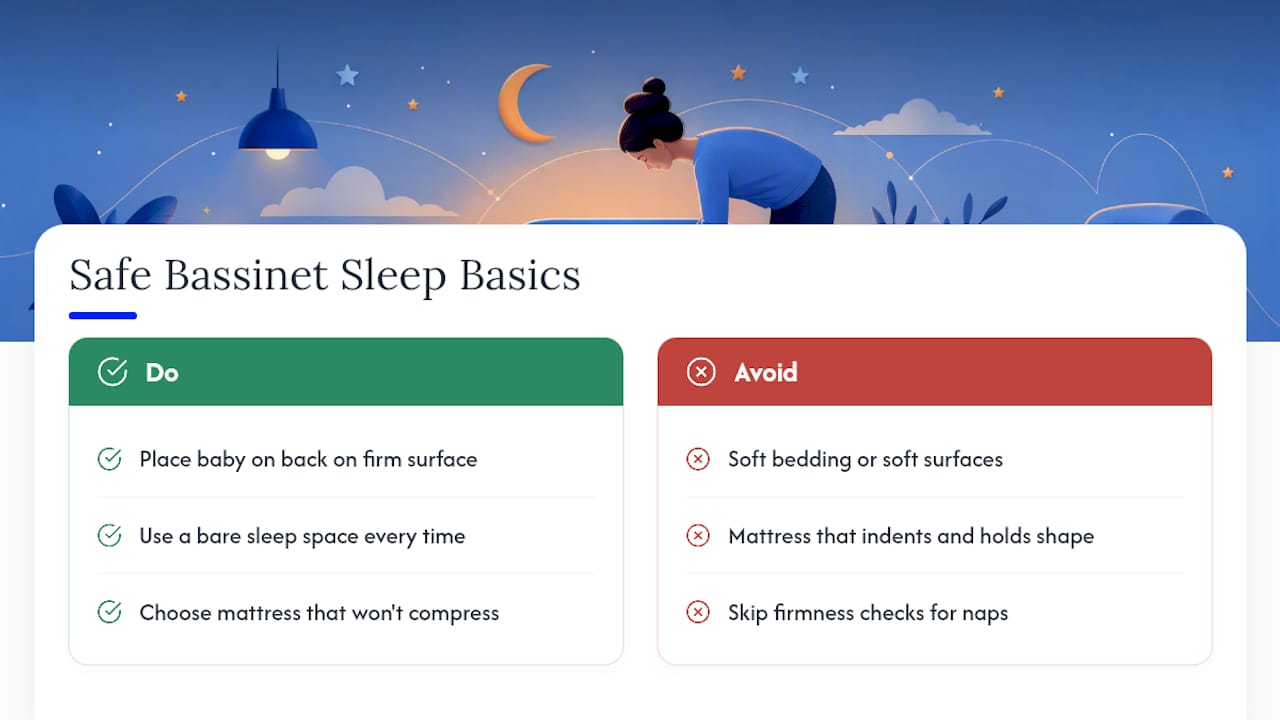
- Firm: it should not sink or cradle around your baby’s body when they wiggle.
- Flat: no inclines, no wedges, no extra padding underneath.
- Fitted sheet only: nothing else in the sleep space, including blankets, bumpers, or pillows.
We know a mattress this firm can feel almost too hard when you press on it yourself. That reaction is normal, and we will get to why it does not translate into discomfort for your baby. For now, the takeaway is simple: firmness is the feature, not a flaw.
Key Takeaways
Bassinet mattresses must stay firm and flat, with no indentation under an infant’s weight, to meet AAP, CDC, and CPSC infant sleep safety standards.
| Point | Details |
|---|---|
| Firm and flat wins | A safe mattress springs back immediately under palm pressure and never sinks or contours. |
| Test it at home | Use the palm press and carton method, then check edges and sheet fit for gaps. |
| Thin is intentional | Thin, firm pads resist curling and gaps far better than thick or cushioned alternatives. |
| Replace at the first sign of wear | Permanent indents, rips, or compression mean it’s time for an OEM-approved replacement. |
| Move on at mobility milestones | Rolling, pushing up, or hitting weight limits signal it’s time for a crib. |
| The Happy Baby Store’s approach | Bassinets like the Anti-Startle Newborn Bassinet ship with a fitted, tested mattress built for that exact frame. |
Primary Sources for Bassinet Mattress Safety
- CDC: Sleep Safely for Babies, the federal guidance behind firm, flat sleep-surface recommendations.
- AAP: Safe Sleep Guidance, the pediatric standard for infant sleep environments.
- CPSC: Crib Safety Tips, covering mattress fit and structural safety standards.
- PMC Study: Measuring Sleep-Surface Softness, the peer-reviewed research behind the home firmness test.
- Testing for Correct Mattress Firmness, the official methodology adapted for parents at home.
This article is general information, not a substitute for advice from a qualified doctor. Consult a qualified healthcare professional about your own circumstances before acting on anything here.
Table of Contents
What Is the Best Bassinet Mattress Firmness for Babies?
The best bassinet mattress firmness is one that does not compress or contour to your baby’s body weight at all, at any point during the night. The CPSC’s crib safety standards treat this as a measurable requirement, not a marketing term, and it applies just as directly to bassinets as it does to cribs.
Why does this specific level of firmness matter so much? Infants under 12 months lack the neck strength and motor control to reposition themselves if their face presses into a soft surface. A firm mattress keeps the sleep surface from forming a pocket around the head, which is exactly the scenario tied to suffocation risk in infant sleep research.
A 2021 peer-reviewed study on infant sleep-surface softness measured how much various commercial sleep surfaces compressed under simulated infant weight, and used that data to build a practical, repeatable firmness test. The researchers found meaningful variation across products marketed as “infant safe,” which is part of why generic softness claims on packaging cannot be your only check.
A mattress that indents and holds that shape under an infant’s weight can create a well that traps exhaled air near the face, raising rebreathing risk. Firmness that snaps back immediately prevents that pocket from forming in the first place.
The AAP’s safe sleep recommendations put this in even simpler terms for parents: put your baby down on their back, on a firm surface, in a bare sleep space, every single time. No exceptions for naps, and no exceptions for a mattress that “feels softer but seems fine.”
Here is the number that should stick with you: infant sleep deaths tied to soft bedding and soft surfaces remain one of the most preventable categories the CDC tracks under sudden infant death syndrome. Firmness is not a comfort feature you can trade off. It is the baseline.
How Do You Test Bassinet Mattress Firmness at Home?
You do not need lab equipment to check whether your bassinet mattress meets the firmness standard. Safety researchers built a version of this test specifically so parents could replicate it with items already in the house, and it takes less than five minutes.
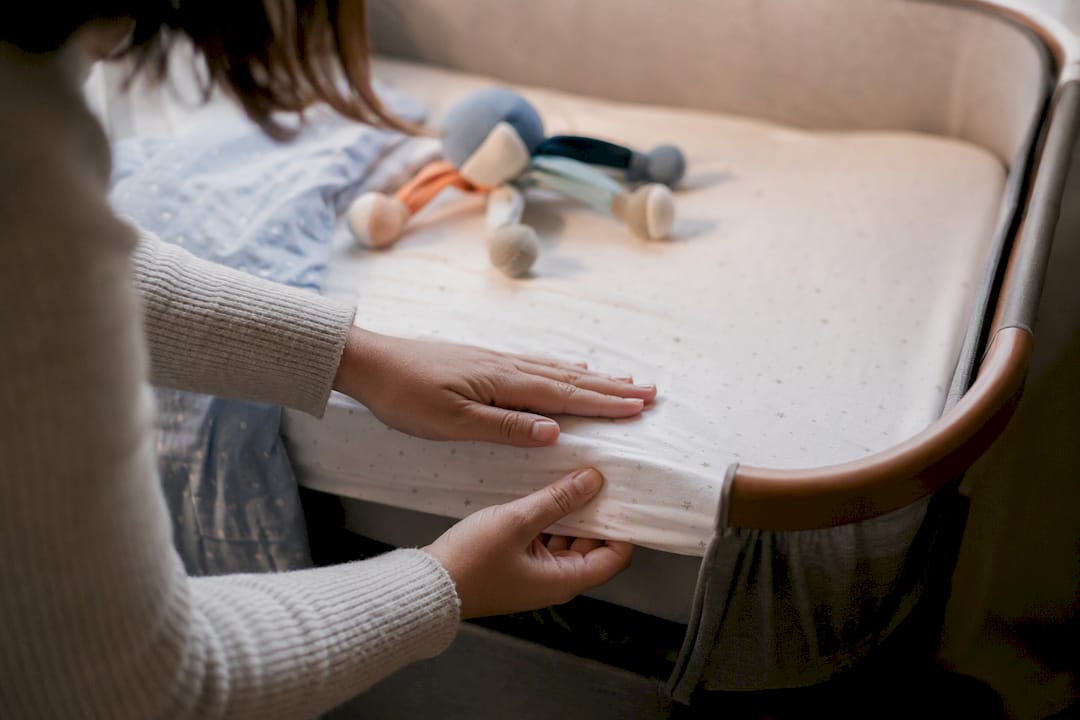
- Press the center with a flat palm. Push down firmly, then release. A safe mattress springs back to its original shape almost instantly, with no lingering dip.
- Run the carton test. Official testing guidance describes placing a stack of items, like a full milk carton or a small stack of CDs, on the mattress and checking how deep it sinks. Minimal, even compression is the goal. A deep, lasting well means the mattress is too soft.
- Check the edges with one finger. Run your finger around the entire perimeter where the mattress meets the bassinet wall. You should not be able to fit more than two fingers into any gap.
- Lay the fitted sheet flat. Put the sheet on and smooth it out. It should sit tight and flat with no bunching, no loose folds, and no room to lift away from the mattress corners.
- Recheck after the sheet comes off for washing. Covers can shift or thin slightly with repeated laundering, so this is worth a thirty-second glance every time you change the bedding.
If the mattress fails the palm test or the carton test, stop using it and check whether the model has a manufacturer-approved replacement before your baby sleeps on it again.
Pro Tip: Keep a mental note of how the mattress felt on day one. Foam breaks down gradually, and the change from “firm” to “getting soft” is easy to miss unless you have a baseline to compare against.
Watch for a few warning signs between checks: a corner that stays compressed longer than a second or two, a cover that has started to separate at the seams, or a fitted sheet that suddenly seems loose where it used to sit snug. Any of those is a reason to test again immediately, not at your next scheduled check.
Why Are Bassinet Mattresses So Thin, and Does That Matter?
Bassinet mattresses run thin on purpose, and thinner is often the safer choice, not a corner-cutting one. A thick, cushiony pad sounds appealing, but it is far more likely to curl at the edges or shift out of position, especially in bassinets with soft or mesh sides rather than rigid frames.
That curling matters because it creates exactly the kind of gap the fit check above is designed to catch. A gap between mattress and wall is an entrapment hazard, and the CPSC has issued direct warnings about products that failed to maintain a tight fit as babies moved during sleep.
What should you actually look for in the materials themselves?
- Firm foam with a wipeable, waterproof cover that does not add bulk or softness on top of the core.
- A mattress tested and sized specifically for your bassinet model, rather than a generic “universal fit” pad.
- A single, snug fitted sheet designed for that exact mattress shape, with no excess fabric pooling at the corners.
And here is what to actively avoid: memory foam toppers, quilted pads, “extra cushion” inserts, or anything marketed as making the surface “cozier.” Memory foam in particular is built to slowly contour to body heat and weight, which is the precise opposite of the immediate spring-back a safe sleep surface needs. If a product description brags about softness, that is a signal to skip it, not a selling point.
My Baby’s Mattress Feels Too Hard. Is That Normal?
Yes, and it is worth saying plainly: a mattress that feels uncomfortably firm to your adult hand is almost always well within the safe range for your baby. Adult comfort expectations are built around surfaces that contour and cushion. A newborn’s comfort needs are built around stability and support, and their body weight is a fraction of what the mattress is designed to resist.
If your baby seems fussy at bedtime, the mattress is rarely the actual cause. A few safe places to look first:
- Room temperature. Overheating is a more common sleep disruptor than surface feel; aim for a room that feels comfortably cool, not warm.
- Sleep clothing. A properly sized sleep sack or wearable blanket often solves restlessness better than anything added to the mattress itself.
- Swaddling, when age-appropriate. Ask your pediatrician about the right window for this, since swaddling stops being safe once a baby starts trying to roll.
- A consistent bedtime routine. Predictability tends to settle babies faster than a softer surface ever will.
Pro Tip: If you are tempted to add a thin blanket “just for warmth,” reach for a sleep sack instead. It solves the same worry without putting loose fabric anywhere near your baby’s face.
If sleep struggles persist despite a comfortable room and a solid routine, especially alongside signs like frequent arching, spit-up during sleep, or unusual breathing patterns, that is a conversation for your pediatrician. Reflux and other medical causes of discomfort need a clinical answer, not a softer mattress.
When Should You Replace a Bassinet Mattress?
Replace a bassinet mattress the moment it shows physical wear, even if your baby has months of eligible bassinet use left. Three signs mean it is time:
- A permanent indentation or soft spot that does not spring back after the palm test.
- Visible compression where the foam has flattened unevenly across the surface.
- Rips, tears, or a separated cover that expose foam or create uneven texture under the sheet.
Any one of these is a stop-using-it-tonight signal, not a wait-and-see situation.
When you do replace it, stick to a mattress made for that exact bassinet model. Manufacturers test the mattress and frame together as one system, and swapping in a generic or aftermarket pad, even one advertised as a universal fit, can quietly undo that testing. Before buying a replacement, confirm the model number matches, check the listed dimensions against your bassinet’s interior, and re-run the fit check described above once it is installed.
When Do You Stop Using a Bassinet Mattress Altogether?
Certain milestones matter more than a printed age limit on the box. Move your baby to a crib once you see any of the following, regardless of how many months are left on the label:
- Rolling over independently, in either direction.
- Pushing up onto hands and knees or attempting to sit unsupported.
- Pulling up toward the bassinet’s sides.
- Reaching the manufacturer’s stated weight or height limit, whichever comes first.
Continued bassinet use past these points raises real tip-over and fall risk, since most bassinets are built lighter and lower to the ground than a full crib and are not rated to handle an actively mobile baby pushing against the sides.
Before you make the switch, run a quick two-part check: measure your baby’s current length and weight against the bassinet’s stated limits, and confirm the crib mattress you are moving to passes the same firm, flat, no-gap tests you just learned. The standard does not change. Only the bed does.
How Does the Happy Baby Store Vet Bassinet Mattress Safety?
We build every bassinet around the same standard this article walks through: firm, flat, and fitted to the frame with no gaps. That is not a claim we make lightly. It is baked into how we select products in the first place, using medical-grade safety standards and a child-tested, parent-approved review process before anything reaches our catalog.
Take the Anti-Startle Newborn Bassinet, for example. It ships with an included mattress sized specifically to that frame, so you are not guessing at fit or hunting for a compatible aftermarket pad. The same goes for the Electric Rocking Baby Bassinet, where the soothing motion features never come at the cost of a firm, flat sleep surface underneath.
If you are ever unsure about a specific model’s mattress dimensions or whether a replacement pad is compatible, our product pages list those specifics, and our support team can walk you through the exact fit check for your bassinet.
What Do New Parents Get Wrong About Mattress Firmness?
Most parents I talk to about this expect the hard part to be finding a firm mattress. It is not. Firm bassinet mattresses are the default; softness is the exception, and usually the exception you have to go looking for, often in the form of an added topper someone bought with good intentions.
The part people underestimate is how quickly a good mattress can become a bad one. A firm surface degrades through ordinary use, through washing, through months of a growing baby pressing on the same few inches every night, and nobody sends you a reminder when that happens. The palm test and the carton test exist precisely because “it looked fine when we bought it” is not a safety check that lasts a whole year.
If you take one thing from this guide, take the habit, not just the standard. Run the checks periodically, not once. Trust a snap-back over a soft sell, and do not let the words “extra cozy” on packaging override what your own palm tells you when you press down. When something feels off and you cannot explain why, that is worth a call to your pediatrician rather than a guess.
— Enrique
Explore Sensory Toys That Support Safe, Happy Playtime
Firm, flat, and fitted only applies to what your baby sleeps on, not what they play with while awake. Once your little one is out of the bassinet and stacking up wake windows, the right sensory toys can do a lot of the developmental heavy lifting, without ever compromising the sleep space you have worked to set up correctly.
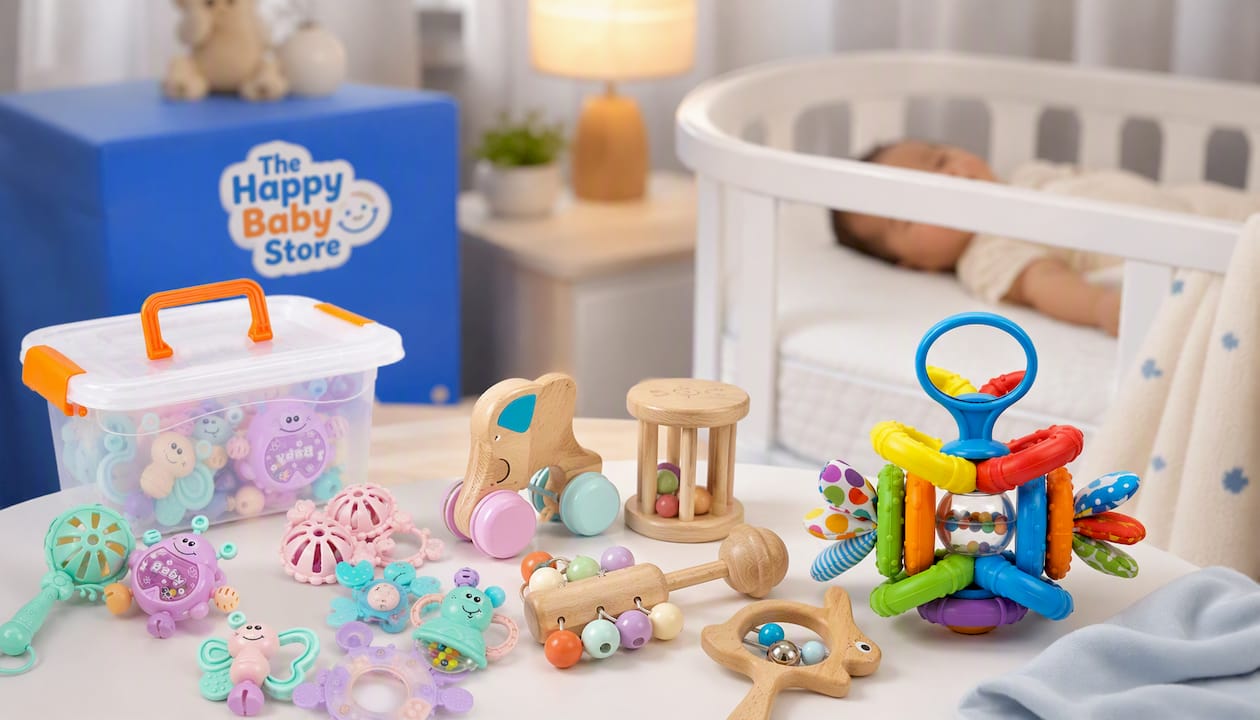
Our Sensory Rattle Toy Set is built for exactly that window between naps, with textures and sounds designed to hold attention without any small, detachable parts near the crib. For a quieter option, the Wooden Beech Educational Toy rattle drum set gives newborns a gentle, tactile way to start building hand coordination. As your baby grows into toddlerhood, the Sensory Development Toy keeps that same hands-on engagement going.
Browse the full range on The Happy Baby Store and check each product page for exact age recommendations before adding one to your cart.
Sources
- CDC: Sleep safely for babies (SIDS guidance)
- AAP: Safe sleep guidance
- A firm recommendation: measuring the softness of infant sleep surfaces (PMC)
- CPSC: Crib safety tips
- Infant sleep safety: testing for correct mattress firmness


