


The mandatory U.S. standard for bassinets and cradles is 16 C.F.R. part 1218, which now incorporates ASTM F2194-25, effective February 21, 2026. If you remember nothing else from this article, remember two things: the sleep surface must tilt no more than 10 degrees from head to toe, and the sleep space must be bare, meaning a fitted sheet and nothing
Related Articles:
How Firm Should a Bassinnet Mattress Be for Safe Baby Sleep?
Bassinet vs Crib: How to Choose Baby's First Bed
How to Pace Feed with a Bottle for Calmer, Baby-Led Feedselse.
Every other rule in the federal standard exists to protect those two facts. A bassinet that leans too steeply can let a baby slide into a position that blocks their airway. A bassinet stuffed with a blanket, positioner, or bumper undoes even a perfectly engineered sleep surface. The CPSC’s safe sleep guidance ties this directly to outcomes: sudden unexpected infant death, or SUID, claims thousands of infants in the United States every year, and unsafe sleep environments are a recurring factor investigators find at the scene.
Here’s what to check before your baby ever sleeps in a bassinet:
- Angle: the sleep surface should sit flat, at 10 degrees or less from head to toe.
- Bedding: nothing but a fitted sheet. No pillows, no wedges, no loose blankets.
- Certification: look for a reference to ASTM F2194 or 16 C.F.R. part 1218 on the label or in the manual.
Key Takeaways
The mandatory bassinet safety standards USA regulators enforce come down to one rule of law and two rules of behavior: follow 16 C.F.R. part 1218 with ASTM F2194-25, keep the incline at 10° or under, and keep the sleep surface bare.
| Point | Details |
|---|---|
| Know the standard | 16 C.F.R. part 1218 incorporates ASTM F2194-25, effective for products made or imported on or after February 21, 2026. |
| Check the angle | The sleep surface must sit at a 10° incline or less from head to toe to reduce suffocation risk. |
| Keep it bare | Use only a fitted sheet. No bumpers, positioners, weighted swaddles, or loose blankets. |
| Verify the CPC | Look for a citation to 16 C.F.R. part 1218 or ASTM F2194 on the label, confirming third-party testing occurred. |
| Shop for compliance | Thehappybabystore vets sleep products against current CPSC and ASTM requirements before listing them. |
Table of Contents
- What Are the Federal Bassinet Safety Standards USA Regulators Enforce?
- What Technical Requirements Keep a Bassinet Safe for Infant Sleep?
- How Do You Know a Bassinet Is Actually Certified?
- What Should You Check Before Buying or Using a Bassinet?
- Why Are Aftermarket Mattresses and Accessories a Hidden Risk?
- How Do You Check Recalls or Report an Unsafe Bassinet?
- How The Happy Baby Store Approaches Safety and Product Selection
- Where to Find Official Bassinet Safety Information
- What Parents Get Wrong About Bassinet Safety Standards
- Find Bassinets and Baby Essentials Built Around These Standards
- Frequently Asked Questions
- Sources
What Are the Federal Bassinet Safety Standards USA Regulators Enforce?
The short version: a voluntary industry standard becomes federal law through a mechanism most parents have never heard of, and it just kicked in for one of the most-used baby products on the market.
The Consumer Product Safety Improvement Act, under Section 104(b)(1), directs the Consumer Product Safety Commission to adopt voluntary safety standards for durable infant products as mandatory federal rules once ASTM International finalizes them. That’s exactly what happened here. ASTM’s technical committee updated its voluntary bassinet and cradle standard, and the CPSC folded that update into 16 C.F.R. part 1218 through incorporation by reference. Once that happens, the ASTM standard stops being optional guidance for manufacturers and becomes enforceable federal law.
The updated version, ASTM F2194-25, took effect on February 21, 2026, per the Federal Register’s direct-final rule. Any bassinet or cradle manufactured or imported on or after that date must meet the new requirements, not the older 2017 version of the standard.
Part 1218 covers more than the classic bedside bassinet. The rule’s scope includes:
- Standalone bassinets and cradles sold as freestanding sleep furniture.
- Play yard bassinet attachments and inserts marketed for infant sleep.
- Bassinet accessories that affect the sleep surface, including aftermarket mattresses.
That last category is new, and it matters. Previous versions of the standard largely assumed babies would sleep on the mattress that came in the box. ASTM F2194-25 closes that gap by regulating replacement mattresses too, since a poorly fitted aftermarket pad can undo every structural safety feature built into the frame.
Two terms worth knowing before you shop: a removable bassinet bed is a sleep basket designed to detach from a stand or stroller frame, and it has its own attachment and latch tests. Intended use orientation refers to how the manufacturer designed the product to sit, rock, or recline during sleep, which determines which angle and stability tests apply to it.
What Technical Requirements Keep a Bassinet Safe for Infant Sleep?
This is where the standard gets specific, and where the gap between a compliant bassinet and a merely attractive one becomes obvious.
Sleep surface angle. The head-to-toe incline of the sleep surface cannot exceed 10 degrees when the bassinet is in its resting position, per CPSC’s business guidance. CPSC’s own safe sleep materials go further, warning against any inclined product for infant sleep beyond that threshold. The reasoning is straightforward: an infant’s neck muscles aren’t strong enough to reposition their head if it slumps forward on an incline, and that posture can compress the airway. The standard also caps lateral angle, so the surface cannot tilt side to side in a way that pools a baby against one wall of the bassinet.
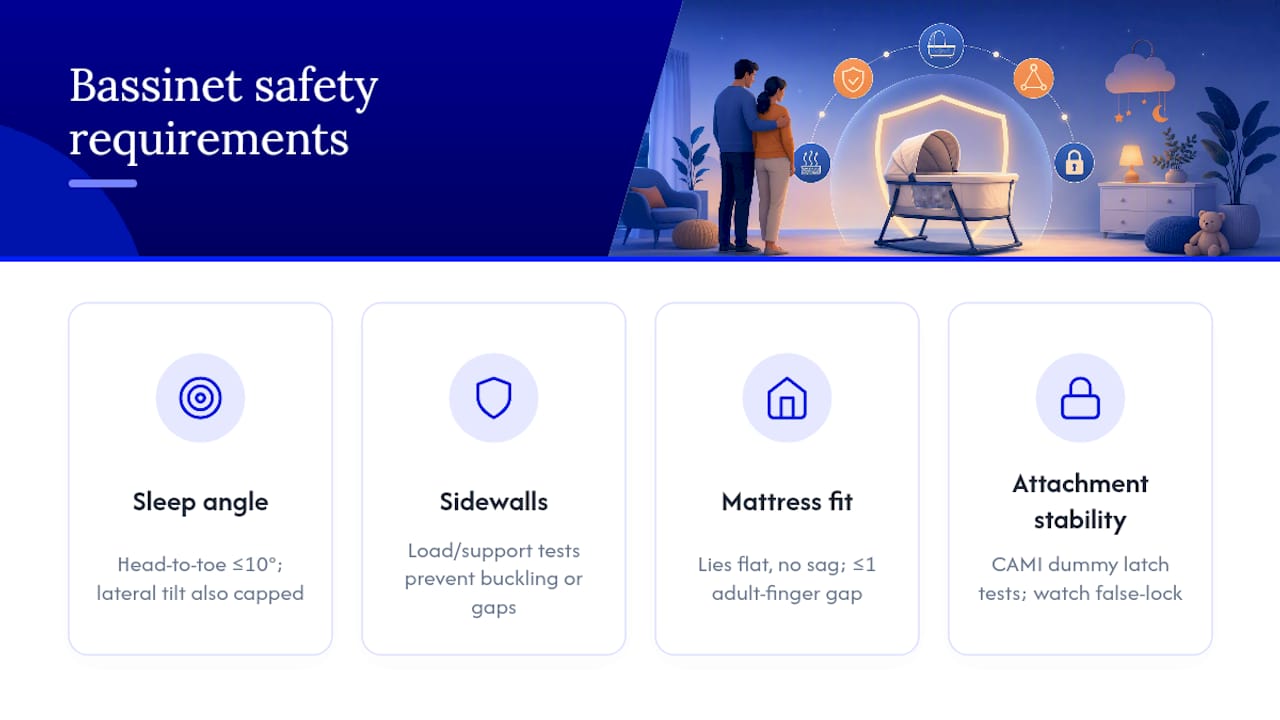
Sidewall integrity and occupant support. Every bassinet, fabric-sided or rigid, has to pass load and support tests that confirm the sides won’t buckle, sag, or create a gap a baby could roll into or get a limb trapped in. Soft-sided bassinets tend to rely on tensioned fabric and internal stays to hold shape; rigid bassinets rely on the frame itself. Both approaches can pass the standard, but a soft-sided bassinet that’s lost its tension over time, from wear or a poorly designed frame, is more likely to fail this test in real-world use than in a lab.
Mattress fit and flatness. The mattress has to lie flat with no visible sag, and the standard includes segmented mattress tests to check that multi-piece pads don’t shift or gap. For parents, the practical version of this test is what’s known informally as the finger-gap rule: if you can fit more than one adult finger between the mattress edge and the bassinet wall, the fit isn’t tight enough. A Consumer Reports analysis on bassinet safety notes that parents frequently judge safety by how a product looks rather than how it performs on these fit and structure tests, which is exactly why the standardized measurements exist.
Removable bed attachment and stability. For bassinets that detach from a stand, stroller frame, or travel system, the standard requires attachment tests using a CAMI newborn test dummy, simulating a real infant’s weight and movement against the latch mechanism. Failure here usually isn’t dramatic. It tends to show up as a latch that looks and sounds secure but isn’t fully locked, sometimes called a false-lock condition, which a parent has no easy way to spot without knowing to check for it. Stability testing separately confirms the bassinet won’t tip when a baby shifts weight toward one side or when someone bumps the stand.
Electrical and battery safety. ASTM F2194-25 added this category for the first time, covering the growing number of motorized, rocking, and app-connected bassinets on the market. These requirements address wiring insulation, battery containment, and safeguards against overheating, on top of the mechanical tests every bassinet has to pass. If you’re considering an electric rocking bassinet, this is the section of the standard that now applies specifically to it, and it’s worth confirming the product’s documentation references these electrical provisions, not just the mechanical ones.
How Do You Know a Bassinet Is Actually Certified?
A tag that says “meets safety standards” means almost nothing on its own. What you’re actually looking for is a Children’s Product Certificate, or CPC, which is the document manufacturers must generate to legally sell a bassinet in the United States.
The CPC isn’t marketing copy. It’s a formal certification, required for children’s products under the CPSIA, stating that the specific bassinet model has been tested by an accredited third-party lab and found compliant with 16 C.F.R. part 1218 and the incorporated ASTM F2194-25 provisions. CPSC’s business guidance lays out exactly what manufacturers and importers must document, and that obligation sits with the manufacturer or importer, not the retailer.
Here’s what to look for on labeling and in the product manual:
- A direct citation to the regulation, either “16 C.F.R. part 1218” or “ASTM F2194,” printed on the product label or included in the instructions.
- Clear warnings against added bedding, positioners, or pillows.
- A stated intended use orientation, telling you whether the product is meant to recline, rock, or sit flat during sleep.
- Mattress specifications, including dimensions and thickness, so you can verify any replacement pad against the original.
- Age and weight limits for use, since these caps tie directly to the tests the product actually passed.
Timing matters here in a way that trips up a lot of shoppers. The February 21, 2026 effective date applies to units manufactured or imported on or after that date, not units sold on or after that date. A bassinet that’s been sitting in a warehouse since 2024 and made it onto a shelf in 2026 was likely built to the earlier 2017 version of the standard, and that’s still legal to sell during the transition. CPSC has also signaled enforcement discretion through June 30, 2026, giving manufacturers a grace period to bring existing inventory and testing paperwork into full alignment. That doesn’t mean the product is unsafe. It does mean two bassinets on the same shelf right now may have been certified against different versions of the standard, so checking the manufacture date alongside the CPC is the best way to know which standard applies to your product.
What Should You Check Before Buying or Using a Bassinet?
Run through this before you swipe a card or set up a bassinet that’s already in your house:
- Check the label for a regulation citation. Look for “16 C.F.R. part 1218” or “ASTM F2194” printed somewhere on the product or in the included manual. If neither appears anywhere, that’s a signal to ask the retailer directly before buying.
- Test the mattress-to-wall gap. With the mattress in place, try to slide a finger between the pad and the bassinet wall. If more than one finger fits, the mattress isn’t sized correctly for that bassinet.
- Confirm the mattress lies flat with no sag. Press gently in the center. A segmented or foam-filled mattress that dips or shifts under light pressure hasn’t held its shape the way the standard requires.
- Eyeball the sleep angle. The surface should look essentially flat, not tilted. If you’re shopping for an inclined sleeper of any kind, know that CPSC guidance explicitly discourages inclined products for infant sleep beyond 10°.
- Keep the sleep space bare. No pillows, no bumpers, no positioners, no loose blankets. A fold-out portable bassinet is exactly as safe as the sheet you put in it and nothing more.
- For powered bassinets, check the electrical documentation. Look for battery containment warnings, cord management instructions, and a certification statement that references electrical safety, not just structural testing.
Pro Tip: Bedside “in-bed” sleepers that attach to your mattress are a different product category, and many aren’t held to the same frame and stability tests as standalone bassinets. If you’re considering one, ask specifically whether it carries a CPC under part 1218, since some of these products fall outside that protective scope entirely.
One more thing worth saying plainly: a beautiful bassinet and a compliant bassinet are not always the same object. Aesthetic details like woven textures or curved wood frames tell you nothing about whether the sidewalls passed a load test.
Why Are Aftermarket Mattresses and Accessories a Hidden Risk?
ASTM F2194-25 added aftermarket mattresses to its scope for a reason: a mismatched replacement pad can quietly erase every structural safety feature a bassinet was built with.
A bassinet’s frame, sidewall height, and stability are all engineered around a specific mattress thickness and shape. Swap in a thicker, softer, or oddly sized pad, and you can create gaps along the edges, raise the effective sidewall height too low relative to the mattress surface, or introduce a soft surface that increases suffocation risk even inside an otherwise compliant frame. That’s exactly the scenario the finger-gap check is designed to catch.
Accessories create a related but separate hazard. None of these belong in a bassinet, regardless of how they’re marketed:
- Crib bumpers or padded liners, which can trap a baby against a soft surface.
- Wedges or positioners sold as reflux or flat-head aids.
- Weighted blankets or weighted swaddles.
- Loose blankets, pillows, or stuffed toys of any kind.
CPSC’s dos and don’ts are unambiguous on this point: bare is best, full stop. No product compliance can offset what a parent adds to the sleep space afterward, which is why this remains the single most repeated piece of safe-sleep advice in every CPSC publication on the subject.
If you need a replacement mattress, the safest move is buying the OEM version made for that exact bassinet model. If that’s not available, verify the replacement’s dimensions against the original manufacturer’s specifications before you buy, not after.
How Do You Check Recalls or Report an Unsafe Bassinet?
Two websites do almost all the work here, and both are run directly by the federal government.
- Search CPSC’s recall database before you buy secondhand or hand-me-down bassinets. Enter the brand name and model number; if you don’t have those, the product’s UPC code usually works too.
- Check SaferProducts.gov for consumer-submitted incident reports, which sometimes surface problems before an official recall is issued.
- File a report if something goes wrong or looks wrong. Include the model number, brand, purchase date and retailer, photos of the defect or hazard, and the serial number if the label includes one.
- Register your bassinet with the manufacturer directly, using the card that usually comes in the box, so you’re notified automatically if a recall is issued later.
For the regulation text itself, the current version of 16 C.F.R. part 1218 lives on eCFR, and the direct-final rule explaining the ASTM F2194-25 update is posted on govinfo.gov. ASTM’s own reading room hosts the voluntary standard text for anyone who wants the underlying test methods in full.
How The Happy Baby Store Approaches Safety and Product Selection
Safety standards are only useful if someone is actually paying attention to them, and that’s the piece of our job we take most seriously. Thehappybabystore built its catalog around a simple filter: medical-grade safety standards first, curated selection second. Every sleep product we carry is checked against current CPSC and ASTM requirements before it ever gets listed, and we track recall notices so we can pull anything flagged, fast.
Not everything in our store is a sleep surface, and that distinction matters more than it sounds. Our Montessori learning toy, sensory rattle set, and beech wood rattle drum set are developmental toys, not sleep products, and they’re evaluated against different safety benchmarks: choking hazard testing, non-toxic finishes, and durability under a teething baby’s grip. They never belong in a bassinet with a sleeping infant, but they’re vetted with the same seriousness we apply to sleep gear.
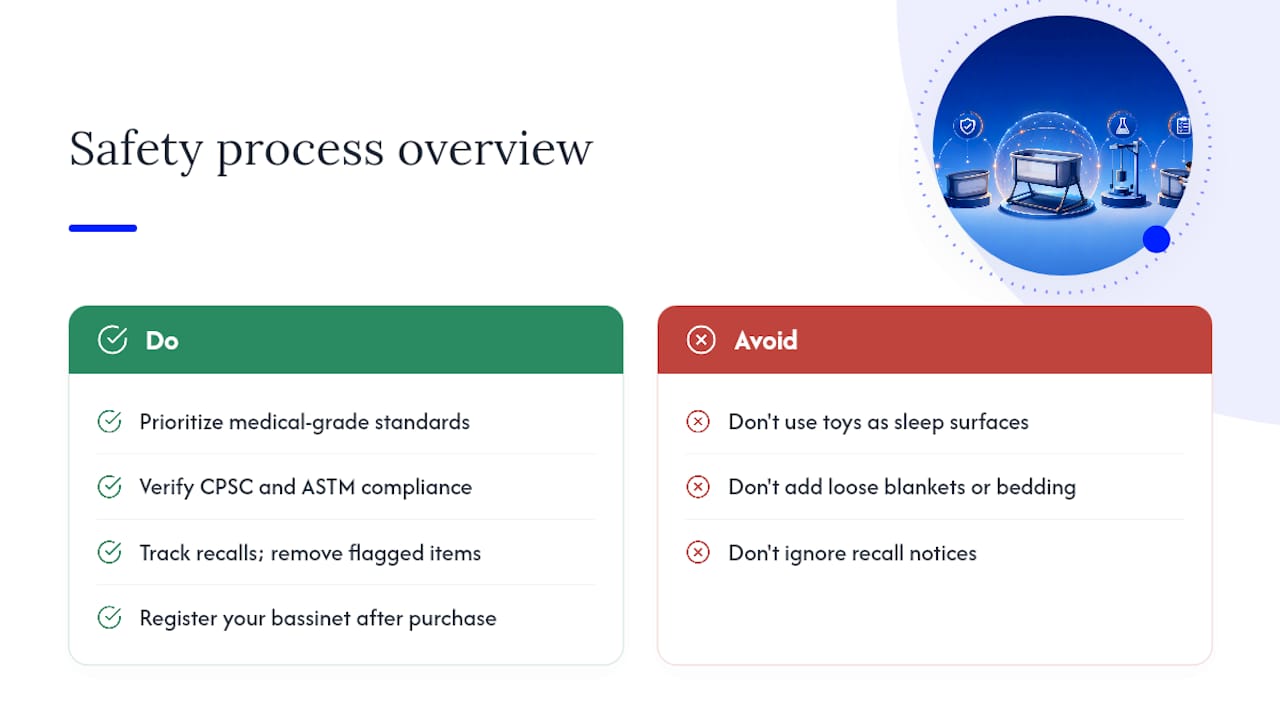
We also help with the paperwork side of safety. If you buy a bassinet through us, our customer support team can walk you through manufacturer registration and point you toward recall monitoring resources, because the safest bassinet is one you’re actually notified about if something changes.
“Bare is best” isn’t a slogan we invented. It’s the standard CPSC has repeated for years because compliance testing can engineer a safer frame, but it can’t stop a parent from adding a blanket that undoes it.
Where to Find Official Bassinet Safety Information
A handful of government sources cover everything you’d want to verify, and none of them require a login or a fee.
- CPSC’s Safe Sleep page for consumer-facing guidance, dos and don’ts, and recall alerts.
- CPSC’s business guidance for bassinets and cradles for the technical requirements manufacturers must meet.
- 16 C.F.R. part 1218 on eCFR for the current, official regulation text.
- The Federal Register direct-final rule explaining exactly what changed with ASTM F2194-25 and why.
- ASTM International’s reading room for the full voluntary standard text referenced by the federal rule.
Bookmark the CPSC recall page specifically. It’s the one resource worth checking every few months for as long as your bassinet is in use.
What Parents Get Wrong About Bassinet Safety Standards
Most safe-sleep advice online treats “certified” as a single checkbox, and that’s the biggest gap between the regulation and how people actually shop. Compliance is a range of specific, testable claims, sidewall load limits, mattress fit, latch reliability, and a bassinet can meet some of those tests brilliantly while a parent unknowingly defeats them with a bumper or the wrong replacement mattress.
The 2025-2026 update to the standard is a quiet admission that the previous rules hadn’t caught up to real product categories: motorized bassinets, app-connected rockers, and a booming secondhand and aftermarket-mattress market. Extending the standard to cover aftermarket mattresses is the single most consequential change for households that reuse or hand down bassinets, which is common and previously fell into a regulatory blind spot.
If you take one thing from the technical detail here, prioritize the finger-gap mattress check over reading every spec sheet. It’s the fastest way to catch a mismatch a lab test alone won’t reveal in your living room.
Find Bassinets and Baby Essentials Built Around These Standards
Reading a federal regulation is one way to protect your baby’s sleep. The faster way is shopping from a store that’s already checked the paperwork for you. Thehappybabystore curates bassinets and sleep gear against current CPSC and ASTM requirements before they ever reach our shelves, so you’re not left cross-referencing 16 C.F.R. part 1218 in the middle of a 2 a.m. feeding.
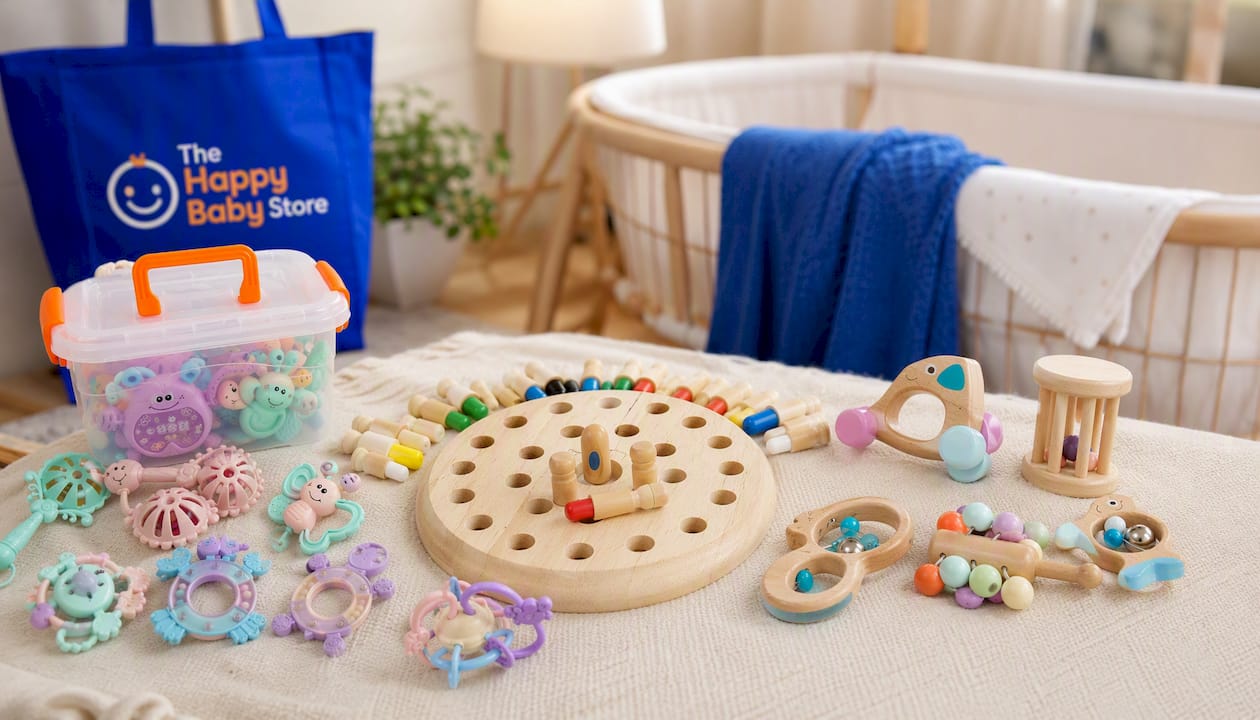
Beyond sleep gear, our catalog covers the rest of the newborn stretch too. The Montessori learning toy and sensory rattle set are popular add-ons for parents outfitting a nursery from scratch, chosen for the same non-toxic, durability-first standards we apply to sleep products. If you’re weighing a foldable portable bassinet against a natural-material option like our corn husk woven bassinet, our product pages list the certification details you now know to look for, so comparing them takes minutes, not an afternoon of label-reading. Browse the current bassinet lineup and check the CPC details on any model before you add it to your cart.
Frequently Asked Questions
What is the current federal standard for bassinets in the United States?
The current standard is 16 C.F.R. part 1218, which incorporates ASTM F2194-25. Bassinets and cradles manufactured or imported on or after February 21, 2026 must meet this updated version rather than the earlier 2017 standard.
What angle is safe for a bassinet’s sleep surface?
The head-to-toe angle must be 10° or less when the bassinet is in its resting position. CPSC guidance also discourages inclined sleep products beyond this limit because of airway compression risk.
Can I use an aftermarket mattress in my bassinet?
ASTM F2194-25 now covers aftermarket mattresses directly, so any replacement pad should match the original manufacturer’s dimensions closely. Use the finger-gap test, no more than one finger between mattress and wall, to confirm the fit before use.
How do I know if a bassinet has a Children’s Product Certificate?
Check the product label or included manual for a citation to 16 C.F.R. part 1218 or ASTM F2194. If neither appears, contact the retailer or manufacturer directly to confirm the CPC exists before buying.
Where do I report a bassinet safety concern?
File a report at SaferProducts.gov with the brand, model number, purchase date, and photos of the issue. You can also search CPSC’s recall database using the same information before buying secondhand.
Are bedside sleepers held to the same standard as standalone bassinets?
Not always. Many bedside “in-bed” sleepers aren’t subject to the same frame and stability testing as standalone bassinets, so verify independent CPC certification before assuming one meets part 1218.
Sources
- Cpsc
- Safety Standard for Bassinets and Cradles — Federal Register (Direct final rule)
- Cpsc
- 16 CFR § 1218.2 - Requirements for bassinets and cradles | LII / Legal Information Institute
Recommended
- Foldable Bassinet for Newborns - Your Essential Portable Cradle – The Happy Baby Store
- Anti-Startle Newborn Bassinet: Cozy, Safe Sleep for Infants – The Happy Baby Store
- Portable Foldable Bionic Bassinet Bed for Infants 0-6m – The Happy Baby Store
- Electric Rocking Baby Bassinet: Comforting Sleep for Infants – The Happy Baby Store


