


Consumer breathing monitors are not proven to prevent SIDS, and the American Academy of Pediatrics does not recommend them for routine use in healthy term babies. The FDA has also warned that most of these wearables and pads aren’t cleared as medical devices at all. The one exception: a pediatrician prescribes a medical-grade monitor for a diagnosed condition, such as apnea or a home oxygen need. For every other family, the safest and best-supported plan is still the basics.
Pro Tip: If you already own a monitor, use it as a comfort tool, not a medical device. It should never replace these safe-sleep habits.
- Place your baby on their back for every sleep, every time.
- Use a firm, flat sleep surface with a fitted sheet only.
- Keep the crib bare. No blankets, pillows, bumpers, or stuffed animals.
- Share your room, not your bed, for at least the first six months.
Key Takeaways
Safe-sleep practices, not consumer breathing monitors, are what medical authorities agree actually reduces SIDS risk in healthy infants.
| Point | Details |
|---|---|
| No monitor prevents SIDS | The AAP and FDA agree consumer breathing monitors don’t reduce SIDS risk in healthy babies. |
| Safe sleep is the proven step | Back sleeping, a firm bare crib, and room-sharing remain the evidence-backed basics. |
| False alarms are common | Consumer Reports and the FDA both flag frequent false alarms and skin irritation risks. |
| Medical monitoring is different |
Physici
Related Articles: How Firm Should a Bassinnet Mattress Be for Safe Baby Sleep?an-prescribed monitors come with training and oversight consumer devices lack. |
| Thehappybabystore offers comfort, not diagnosis | Its video and intercom monitors support supervision and nursery comfort without vital-sign claims. |
This article is general information, not a substitute for advice from a qualified doctor. Consult a qualified healthcare professional about your own circumstances before acting on anything here.
Table of Contents
- Is a Breathing Baby Monitor Safe? What the Medical Authorities Say
- How Do Baby Monitors Track Breathing?
- What Are the Risks and Limitations of Breathing Monitors?
- When Does a Doctor Recommend Home Breathing Monitoring?
- How to Choose a Safe Baby Monitor If You Still Want One
- The Happy Baby Store’s Approach to Nursery Monitoring
- Why the “More Monitoring” Instinct Often Backfires
- Give Your Nursery the Comfort Layer Monitors Can’t Provide
- Sources
Is a Breathing Baby Monitor Safe? What the Medical Authorities Say
The short version: no major medical body endorses breathing monitors as a way to prevent SIDS in healthy infants, and one federal agency has specifically warned against them.
In September 2025, the FDA issued a safety communication telling parents not to rely on unauthorized wearable infant devices to monitor vital signs. The agency found that many of these products aren’t FDA-cleared, can miss real health problems, and may cause skin irritation or false alarms. That’s a significant distinction most product packaging doesn’t make clear: a monitor that looks and sounds medical isn’t necessarily built or tested to a medical standard.
The AAP’s position through HealthyChildren.org is just as direct. Home apnea and breathing monitors have not been shown to lower SIDS risk in healthy babies, and the organization advises against routine use outside specific clinical situations. Mayo Clinic’s guidance echoes the same conclusion: safe-sleep practices, not monitoring gadgets, are what actually move the needle on risk.
Consumer Reports investigated consumer wearables and found a pattern of expert concern: false alarms, unproven accuracy, and privacy gaps in devices that sync data to an app. A pediatrician quoted by University of Utah Health put it plainly: these devices measure heart rate and oxygen in theory, but they’re not intended to diagnose disease, and they commonly cry wolf.
Peer-reviewed research backs up that caution. Studies indexed on PubMed point to real limits in sensitivity and specificity, often based on small samples. The evidence simply hasn’t caught up with the marketing.
- The FDA has not cleared most consumer breathing monitors as medical devices.
- The AAP explicitly says these monitors don’t reduce SIDS risk in healthy infants.
- Consumer Reports flags false alarms and privacy issues as recurring problems.
- Peer-reviewed studies show mixed, limited accuracy data.
How Do Baby Monitors Track Breathing?
Three basic technologies dominate this category, and each one measures something slightly different.
Wearable socks and wraps sit directly on your baby’s foot or torso and use contact sensors, sometimes claiming pulse oximetry, to estimate heart rate and oxygen saturation. Placement matters enormously here. A sock that’s slightly loose or a wrap that shifts overnight can throw off the reading entirely, which is part of why false alarms are so common.
Mattress and movement pads sit under the crib mattress and try to detect the tiny motions of a chest rising and falling. They’re non-contact, which some parents prefer, but they’re also sensitive to outside vibration. A sibling bumping the crib, a nearby fan, or even a soft mattress can register as a false reading.
Camera-based systems use motion-detection algorithms to estimate breathing rate from video, without touching your baby at all. These tend to have fewer skin-contact issues but rely heavily on lighting, camera angle, and clear line of sight to the chest.
Each approach carries its own trade-off:
- Contact devices (wearables) offer more direct data but higher risk of irritation and misplacement.
- Non-contact pads avoid skin contact but are prone to environmental interference.
- Camera systems skip physical contact entirely but depend on unobstructed viewing conditions.
- Many devices connect over Wi-Fi or an app, which raises separate privacy and data-security questions worth asking about before you buy.
What Are the Risks and Limitations of Breathing Monitors?
Understanding the downside here matters as much as understanding what these devices claim to do.
A false positive is an alarm that goes off when nothing is actually wrong. A false negative is far more dangerous: the device stays silent during a real problem. Both erode trust over time, and repeated false alarms create what clinicians call alarm fatigue, where parents start ignoring warnings altogether, sometimes right before one turns out to be real.
The documented harms go beyond nuisance alerts. The FDA’s warning specifically cites skin irritation from prolonged wearable contact. Some monitor models have faced recalls tied to overheating charging units, and reporting on device performance has documented cases where inaccurate readings sent anxious parents to the emergency room for a problem that didn’t exist.
Privacy is a separate concern entirely. Any device that syncs breathing or video data to an app or the cloud is a device that stores your baby’s health information somewhere outside your home. Ask what happens to that data, who can access it, and whether it’s encrypted.
Setup and environment cause plenty of everyday errors too. A review of under-mattress monitor performance found that crib support type and surface vibration materially affect readings, meaning the same device can perform very differently in two different nurseries.
- False alarms are common enough to be a defining feature of this product category, not a rare glitch.
- Skin irritation and overheating recalls are documented, real-world harms.
- Wi-Fi and app-connected devices carry data-privacy exposure.
- Crib vibration and mattress firmness can trigger inaccurate readings.
Pro Tip: Before buying anything with an app, search the manufacturer’s name plus “recall” and check the FDA’s recall database directly. It takes two minutes and can save a lot of stress later.
When Does a Doctor Recommend Home Breathing Monitoring?
Physician-prescribed monitoring is a different category entirely from anything sold on a general retail shelf, and it’s reserved for a narrow set of medical situations.
- Diagnosed apnea. A baby who has had documented episodes of stopped breathing, confirmed in a hospital setting, may be sent home with a prescribed monitor as part of an ongoing care plan.
- Home oxygen dependence. Infants who need supplemental oxygen at home often require monitoring as a standard part of that therapy.
- Complex cardiopulmonary conditions. Babies with certain heart or lung diagnoses may need continuous monitoring under a doctor’s direction.
- Very preterm infants. Some babies born significantly early go home with a physician-directed monitoring plan, especially if apnea was an issue in the NICU.
The gap between this and a consumer purchase is bigger than most parents expect. Physician-prescribed monitoring comes with clinical-grade equipment, a defined protocol, scheduled follow-up appointments, and hands-on training for parents. A device bought online, however well reviewed, includes none of that oversight. If your baby has a diagnosed condition, this conversation belongs with your pediatrician, not with a product listing.
How to Choose a Safe Baby Monitor If You Still Want One
If you’ve weighed the evidence and still want a monitor for peace of mind, that’s a reasonable choice for plenty of families. Just choose with your eyes open, and treat the device as a comfort tool rather than a safety guarantee.
- Talk to your pediatrician first. Explain why you’re considering a monitor. They can tell you if there’s any clinical reason to consider a prescribed device instead.
- Read the intended-use disclaimer. Most consumer packaging will state, in small print, that the device is not intended to diagnose, treat, or prevent any condition, including SIDS. If it doesn’t say that clearly, be skeptical.
- Check for FDA clearance language. Very few consumer wearables carry it. That’s not automatically disqualifying, but you should know what you’re buying.
- Favor devices that alarm in the nursery, not just through a phone app several rooms away. A loud local alert reaches you faster than a push notification.
- Look up the recall history before you buy, and confirm the return policy in case the device doesn’t perform as advertised.
- Ask about battery and charging safety, since overheating during charging has been a documented issue in this category.
Pro Tip: If an alarm ever sounds, check your baby’s color, breathing, and responsiveness before assuming it’s a false alarm. If your baby is unresponsive or not breathing normally, call 911 immediately. If they seem fine, reset the device and note what happened for your pediatrician.
The Happy Baby Store’s Approach to Nursery Monitoring
Thehappybabystore builds every monitor around the honesty this topic deserves: none of our video or audio monitors are medical devices, and none claim to detect breathing or prevent SIDS. What they do well is give you eyes and ears on your baby without the false-alarm anxiety that comes with vital-sign wearables.
Our remote video monitor and baby sleep monitor with intercom both alarm locally and let you check in visually, which fits the “alarm in the room, not just the app” guidance above. A monitor with its own color screen skips the Wi-Fi privacy question entirely for parents who’d rather not stream to a phone.
- Video and intercom monitors: visual and audio check-ins, no vital-sign claims.
- Closed-unit displays: fewer app/privacy trade-offs than Wi-Fi-only systems.
- Nursery comfort items, like a supportive anti-startle bassinet, support safe-sleep setup directly.
None of these replace a physician-prescribed device if your baby has a diagnosed medical need.
Why the “More Monitoring” Instinct Often Backfires
The instinct to buy more monitoring is understandable, but the evidence points somewhere less comfortable: more consumer monitoring often means more false alarms, not more safety. That’s the part conventional advice glosses over. Parents are sold peace of mind, but what they frequently get is a device that cries wolf until they stop trusting it, right around the time trust matters most.
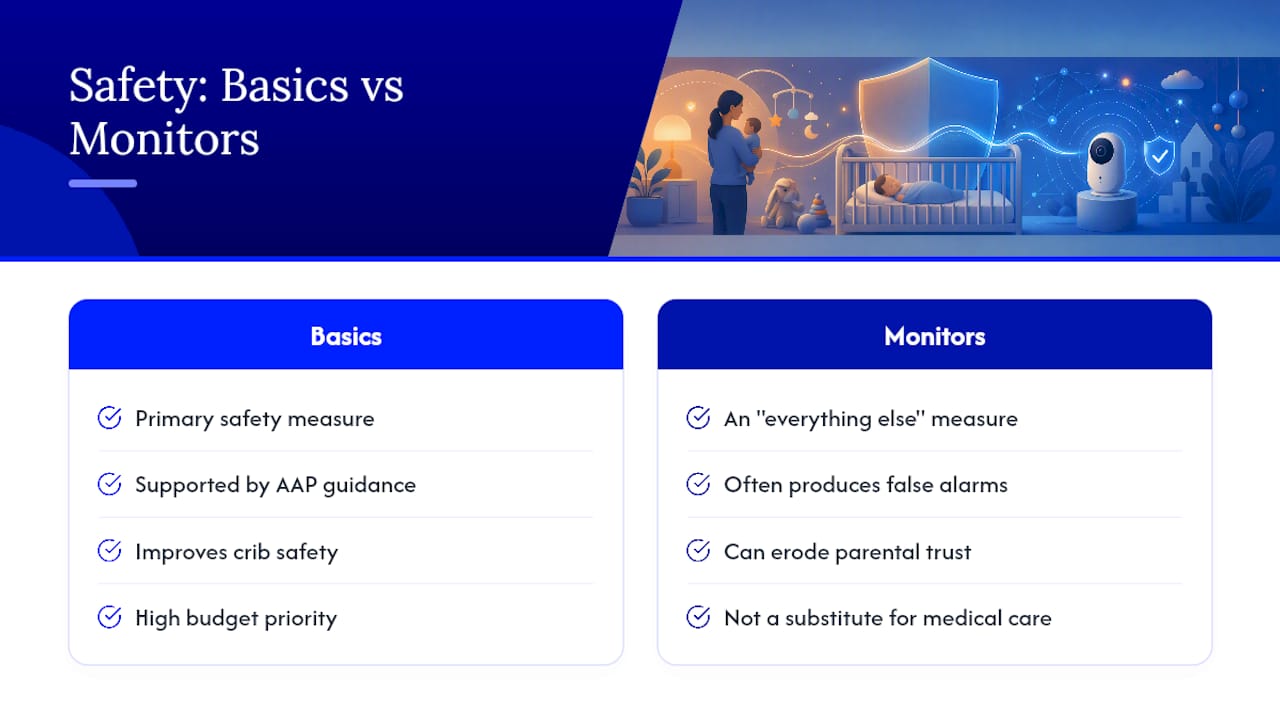
Where I think the conventional wisdom falls short is in treating “monitor versus no monitor” as the real decision. The real decision is “safe-sleep basics versus everything else,” and monitors sit firmly in the “everything else” column for the vast majority of healthy babies. The AAP’s guidance isn’t a soft suggestion, it’s the closest thing to a settled answer this topic has.
If you want a monitor for your own comfort, buy one that doesn’t pretend to be medical equipment. Save the clinical-grade decision for your pediatrician, and put your real safety budget into the crib, the mattress, and the sleep position.
— Enrique
Give Your Nursery the Comfort Layer Monitors Can’t Provide
Once you’ve settled the safety basics, the next upgrade for most families isn’t another sensor. It’s making the nursery itself softer, calmer, and more engaging for the hours your baby is awake. Thehappybabystore built its comfort and play line for exactly that gap: gear that supports real developmental time on the floor, not another device promising to watch your baby’s vital signs.
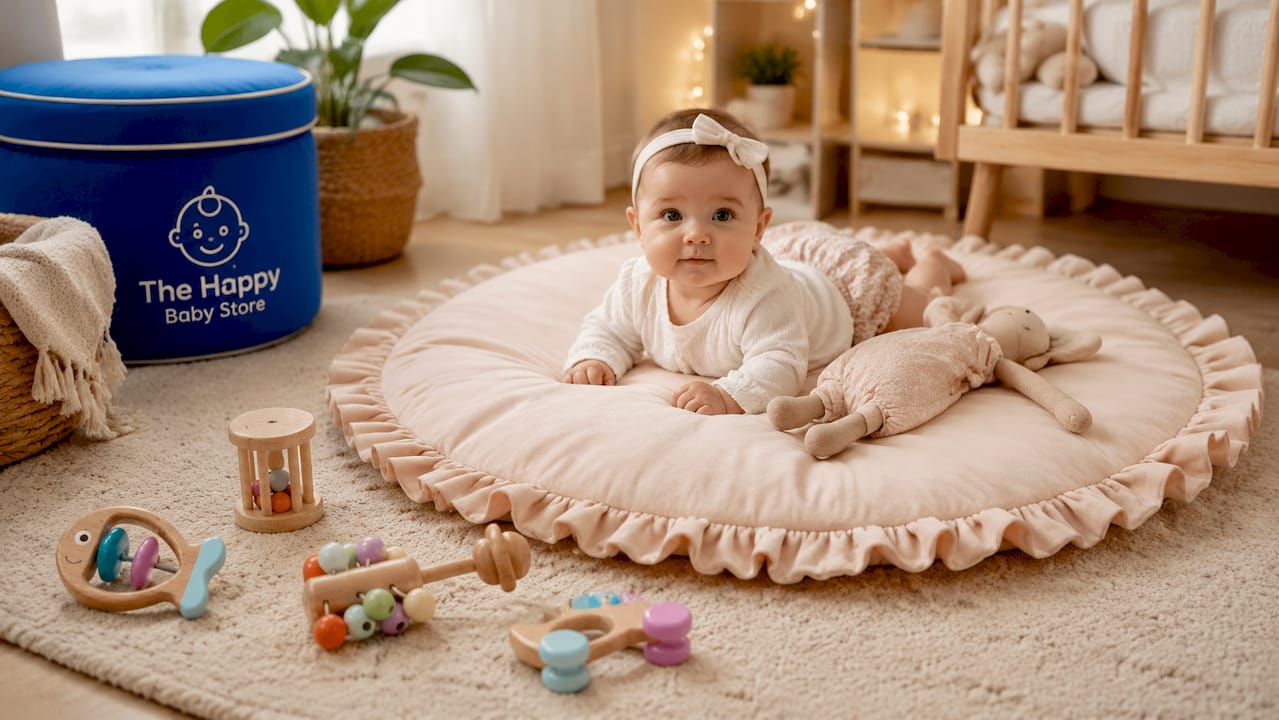
The round plush play mat with drawstring storage gives infants a cushioned, contained space for supervised tummy time, and it packs away in seconds when you need the floor back. If you’d rather have a cotton-padded surface for daily use, the cotton padded play mat offers the same safe-play footprint with a different feel underfoot. Pair either one with the wooden beech rattle drum set to give newborns something worth reaching for during those alert, awake stretches. Browse the full nursery comfort collection and pick the pieces that fit your baby’s stage.
Sources
- FDA safety communication: Do not use unauthorized infant devices for monitoring vital signs
- Healthychildren
- Most Babies Don’t Need a Wearable Breathing Monitor, Doctors Say — Consumer Reports
- Are wearable baby monitors safe for sleep? A pediatrician explains — University of Utah Health
- PubMed: Representative study on infant monitoring accuracy
Recommended
- Remote Baby Monitor Camera | Peace of Mind for Parents – The Happy Baby Store
- Baby Sleep Monitor with Intercom: Ultimate Peace of Mind for Parents – The Happy Baby Store
- Wireless Video Baby Monitor for Stress-Free Parenting | Happy Baby – The Happy Baby Store
- 5 Inch Color Screen Baby Monitor – Peaceful Parenting | Happy Baby – The Happy Baby Store


