


For soft infant and toddler carriers, the standard that matters is ASTM F2236, enforced by the CPSC through 16 CFR part 1226. Products manufactured after February 22, 2025 must meet ASTM F2236-24 specifically. Sling and hand-held carriers fall under separate standards (F2907 and F2050). Check the carrier’s tracking label or Children’s Product Certificate to confirm which version applies to your carrier’s manufacture date.
TL;DR:
- Carriers manufactured after February 22, 2025, must meet the ASTM F2236-24 standard, covering soft-structured, wrap, and multi-position designs.
- Testing requires both static and dynamic load evaluations, as well as occupant retention, fastener, and label durability checks.
- Manufacturers need to identify the correct ASTM version for their production date and keep detailed lab reports and certificates of compliance.
- Parents should verify product compliance via permanent labels, certificates, and warning labels, and directly ask sellers for test documentation if unsure.
- Using carriers tested to outdated standards or lacking proper labeling increases the risk of non-compliance and safety concerns.
Table of Contents
- What Does ASTM F2236 Cover?
- How Does CPSC Turn ASTM Standards Into Law?
- What Tests Must a Baby Carrier Pass?
- Which ASTM Standard Applies to Your Carrier?
- A Step-by-Step Compliance Checklist for Manufacturers
- How Can Parents Verify a Carrier Is Compliant?
- An Editorial Take on Carrier Safety Standards
- Shop Compliant Baby Products at The Happy Baby Store
- Sources
What Does ASTM F2236 Cover?
ASTM F2236 governs soft infant and toddler carriers, the category that includes most of what parents actually buy: soft-structured carriers, wrap-style carriers, and multi-position designs that let you carry a baby on your front, hip, or back. The scope language centers on carriers used with children roughly 7 to 45 pounds, though the exact cutoffs depend on the manufacturer’s stated fit range and the specific version of the standard in effect.
Carriers commonly falling under F2236 include:
- Soft-structured carriers with buckles and a padded seat panel
- Wrap-style carriers made from a long piece of fabric tied around the body
- Multi-position carriers that convert between front, hip, and back carry
Hybrid designs complicate this. A carrier that combines sling-like fabric with structured panels might actually need testing under both F2236 and F2907, depending on how the child is supported. If a design doesn’t cleanly match a single category, the manufacturer’s best move is reviewing the standard’s own scope section and asking a testing lab to weigh in before production, not after.
How Does CPSC Turn ASTM Standards Into Law?
ASTM writes its standards through a voluntary consensus process involving manufacturers, testers, and safety advocates. ASTM has no enforcement power on its own. A standard becomes legally binding only when the CPSC reviews it under the Danny Keysar Child Product Safety Notification Act and formally incorporates it by reference into the Code of Federal Regulations.
For carriers, that incorporation lives in three places:
- 16 CFR part 1226 covers soft infant and toddler carriers (ASTM F2236)
- 16 CFR part 1228 covers sling carriers (ASTM F2907)
- 16 CFR part 1225 covers hand-held infant carriers (ASTM F2050)
Each part specifies which ASTM revision is the “Commission-accepted version” for a given manufacturing period. The Federal Register notice adopting F2236-24 spells out the exact effective date. If your carrier was manufactured before that date, an earlier version might still govern it. Reading the Federal Register docket directly, rather than relying on a summary somewhere online, is the only way to be certain which text applies to your product’s timeline.
What Tests Must a Baby Carrier Pass?
The standard isn’t just paperwork. It requires physical testing that simulates how a carrier behaves under real stress, and both static and dynamic conditions get checked separately.
Static load testing confirms the carrier holds a fixed weight without seams or straps failing. Dynamic load testing goes further, cycling the carrier through repeated stress to mimic a parent walking, bending, or picking up a diaper bag while babywearing. A carrier can pass one test and fail the other, which is why the standard requires both.

Pro Tip: If a manufacturer can’t produce a dynamic load test report alongside the static one, treat that as a red flag. Both are required, not optional, under the Commission-accepted version of F2236.
Other required checks include:
- Occupant retention testing, which uses a sphere or truncated cone tool to confirm leg openings can’t let a baby slip through
- Fastener and strap testing, confirming buckles and adjusters hold under repeated use
- Label permanence testing, confirming warnings and tracking information survive washing and wear
Manufacturers typically contract accredited third-party labs for this work and keep the reports on file, since they’re the backbone of the Children’s Product Certificate. Separately, the Danny Keysar Act requires durable products like carriers to carry permanent tracking labels and registration forms so recalls can actually reach the families who own the product.
Which ASTM Standard Applies to Your Carrier?
Matching a design to its correct standard is where a lot of otherwise careful manufacturers stumble. Here’s the basic map:
- Soft-structured, wrap, and multi-position carriers → ASTM F2236 (16 CFR part 1226)
- Sling-style carriers → ASTM F2907 (16 CFR part 1228)
- Hand-held infant carriers (like bucket-style carriers) → ASTM F2050
- Frame backpack carriers for older toddlers → ASTM F2549
Hybrid products (a sling with structured padding, for instance) sometimes need to satisfy more than one standard’s requirements. Testing to the wrong one is a documented compliance failure that shows up repeatedly in CPSC sling carrier guidance, and it doesn’t just cost money to fix. It can trigger a Children’s Product Certificate dispute or, worse, a recall after the product is already in homes.
A Step-by-Step Compliance Checklist for Manufacturers
Getting from design to a legally sellable carrier means working through the requirements in order, not skipping ahead to certification.
- Identify the carrier’s category and confirm the Commission-accepted ASTM version for your manufacture date.
- Send samples to an accredited third-party lab for static load, dynamic load, and occupant retention testing under that version.
- Issue a Children’s Product Certificate citing the correct 16 CFR part and ASTM version, backed by the lab reports.
- Apply permanent tracking labels, include product registration forms, and write warning language that matches the standard’s text.
- Monitor the Federal Register for new CPSC notices, since a revised ASTM version can shift your compliance obligations mid-production run.
Pro Tip: Keep a dated file of every lab report and CPC you issue. If the CPSC ever incorporates a newer ASTM revision, you’ll need to show exactly which version your existing inventory was tested against.
How Can Parents Verify a Carrier Is Compliant?
You don’t need a lab coat to check this. Look for a permanent tracking label sewn into the carrier with the manufacturer’s name, contact information, and date of manufacture. That label, along with a product registration form in the box, is required under the Danny Keysar Act, not a nice extra.
A few more things worth checking before you buy:
- A permanent label with manufacturer contact info and manufacture date
- Reference to a Children’s Product Certificate or accessible compliance information
- Clear warning language about leg openings, weight limits, and proper use
- A registration form or QR code for recall notifications
| What to look for | Why it matters |
|---|---|
| Permanent tracking label | Confirms manufacture date and enables recall tracing |
| CPC citation or compliance info | Shows the product was tested to the correct standard |
| Registration form | Lets you receive recall notices directly |
| Clear warning labels | Confirms label permanence testing was done |
A reasonable seller should be able to point you to test reports or a CPC on request. If a company dodges the question entirely, that’s worth noting. At The Happy Baby Store, product pages for carriers like our soft-structured carrier and sling-style carrier are built to make this information easy to find, not buried in fine print.
An Editorial Take on Carrier Safety Standards
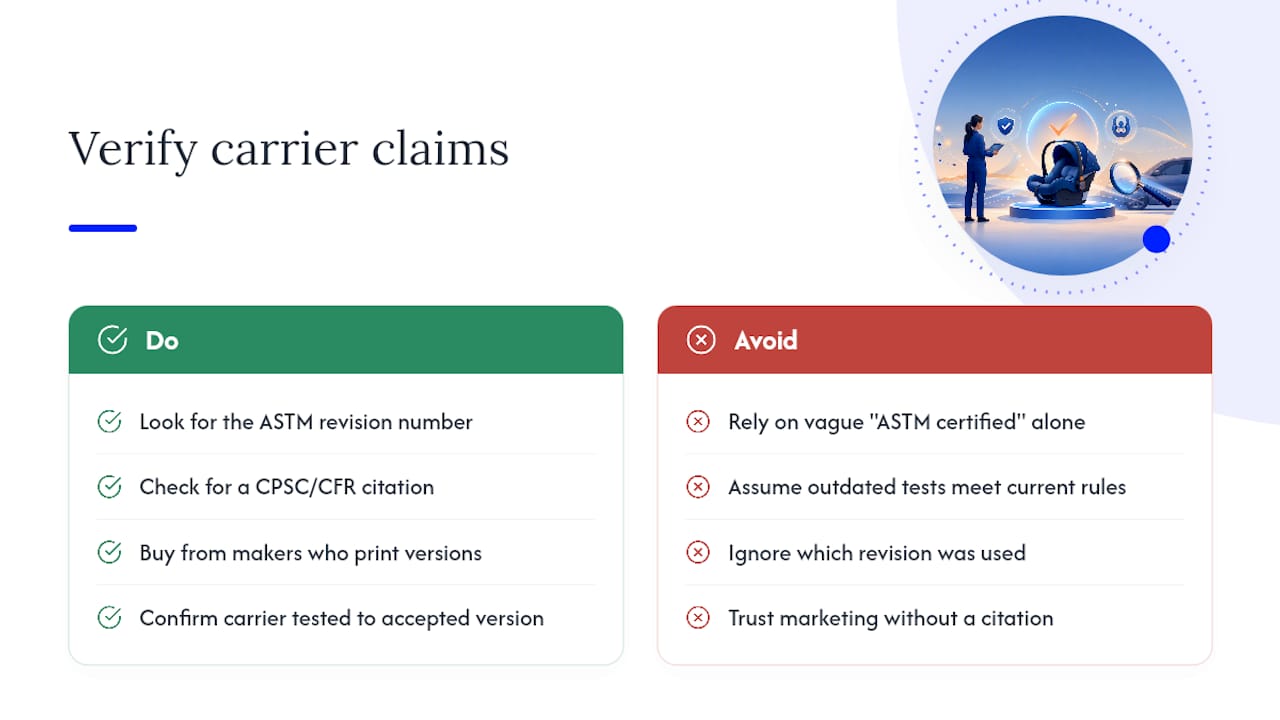
The gap most parents don’t see is between “ASTM certified” as a marketing phrase and “tested to the Commission-accepted version” as a legal fact. Plenty of listings wave the ASTM name around without ever naming which revision, and that’s the detail that actually matters. A carrier tested to an outdated version isn’t automatically dangerous, but it also isn’t automatically compliant with what CPSC currently requires.
What frustrates me about how this topic usually gets covered is the assumption that parents should just trust a label and move on. You shouldn’t have to be a compliance officer to buy a carrier safely, but knowing the difference between a vague safety claim and a specific CFR citation puts real power back in your hands. Manufacturers who do this right aren’t hiding the version number. They’re printing it.
— Enrique
Shop Compliant Baby Products at The Happy Baby Store
Thehappybabystore curates every product with the same question this article just walked through: can we show you exactly what standard it meets and why? That’s the difference between browsing a random marketplace listing and shopping somewhere that puts compliance information where you can actually find it.
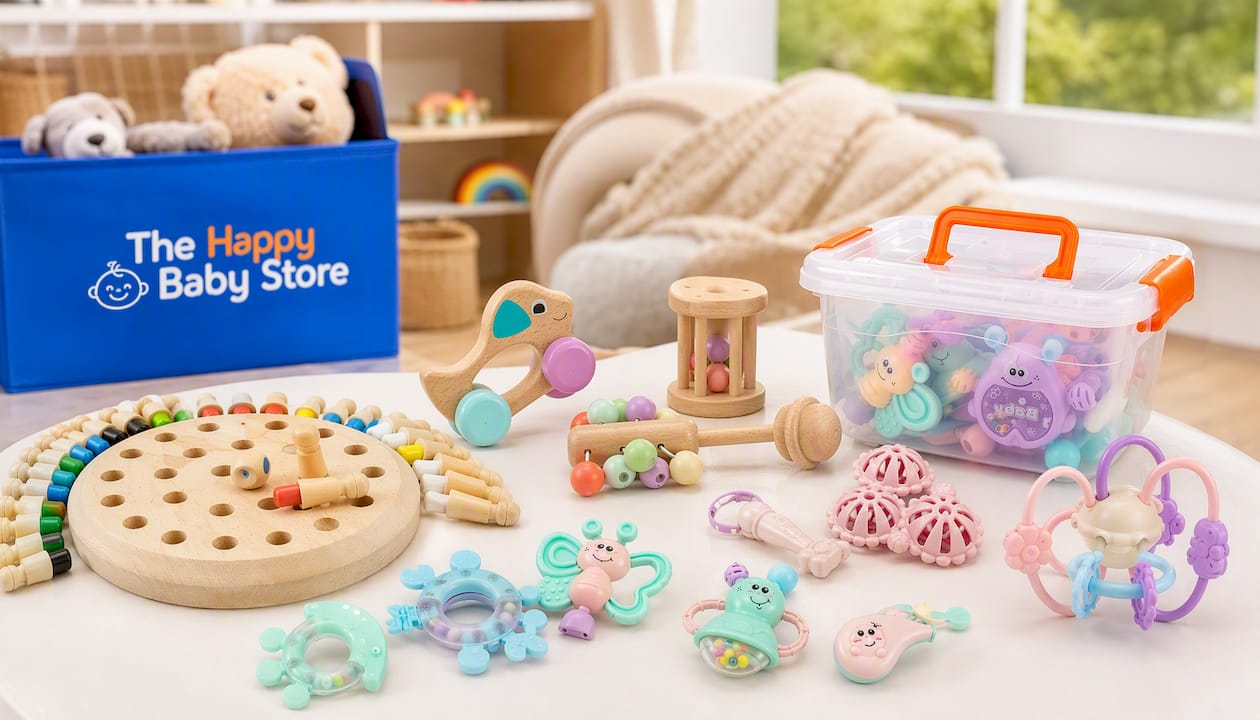
Beyond carriers, our developmental toy selection gets the same scrutiny. The Montessori learning toy built to spark early development, the sensory rattle toy set designed for infant engagement, and the wooden beech rattle drum set for newborns are all part of a catalog chosen for safety first, not just style. If you’re weighing carrier options, our full carrier lineup is a solid place to start, and if you’re planning travel with your little one, this infant passport photo guide covers a detail most new parents overlook. Have a specific compliance question about a model? Reach out to our customer service team before you check out, and we’ll walk you through exactly what testing and labeling stands behind it.
This article is general information, not a substitute for advice from a qualified lawyer. Consult a qualified legal professional about your own circumstances before acting on anything here.
Sources
- Cpsc
- Safety Standard for Soft Infant and Toddler Carriers — Federal Register
- PART 1226—SAFETY STANDARD FOR SOFT INFANT AND TODDLER CARRIERS (govinfo)
- Consumer safety standards | ASTM International


