


Toy rotation means keeping a small, curated set of toys out at any given time while the rest wait in storage, ready to reappear when playtime gets stale. The quickest way to start: pick 4 to 10 toys your child loves right now, tuck everything else into bins out of sight, and watch what happens over the next few days.
Books, some daily comfort favorites, and open-ended art supplies are the exceptions. Leave those out no matter what. Everything else goes into the rotation pool.
Your five-minute starting checklist:
- Gather every toy currently on the floor or shelves into one pile
- Set aside books, a favorite stuffed animal, and any active art project
- Choose 6 to 8 remaining toys to leave out
- Box or bag the rest and stash it in a closet, under a bed, or in the garage
Key Takeaways
Toy rotation works because a small, visible set of toys produces longer and more creative play than a large, cluttered one, and the system stays sustainable only when swaps are partial and low effort.
| Point | Details |
|---|---|
| Keep 4 to 10 toys out | This range promotes focus without overwhelming a toddler’s attention. |
| Rotate every 1 to 2 weeks | Use this as a default, but let ignored toys or restless play cue an earlier swap. |
| Sort by category first | Building, pretend, sensory, and art buckets make balanced rotation sets easy to build. |
| Protect anchor toys | Comfort items, books, and daily favorites stay out permanently, never rotated. |
| Use opaque storage for hidden sets | Thehappybabystore’s crawling mat with storage and activity cubes double as durable, out-of-sight-ready rotation pieces. |
Table of Contents
- What Toy Rotation Ideas Are Built On
- Real Benefits Parents Notice at Home
- How to Set Up a Toy Rotation System Step by Step
- Toy Rotation Ideas by Category and Age
- Storage Bins and Small-Space Setup
- How Often Should You Rotate Toys?
- Adjusting Toy Rotation for Different Ages and Siblings
- Getting Kids on Board With Toy Rotation
- What I’d Tell a Friend Setting This Up
- Give Your Rotation System the Right Tools
- Sources
What Toy Rotation Ideas Are Built On
Fewer toys out doesn’t mean less play. It usually means better play. When a toddler faces sixteen options scattered across the floor, attention splinters. When the same child faces four toys, a 2018 study in Infant Behavior and Development found they engaged in longer, more creative sessions with each item. Less visual noise, more sustained focus.
That’s the mechanism behind every rotation system: novelty resets when a toy disappears and reappears weeks later. A dump truck a child ignored in March can feel brand new in April, simply because it left the room for a while. Montessori-informed guidance settles on 4 to 10 toys as the sweet spot for most toddlers and preschoolers, a range that shows up again and again across parenting practitioners.
What parents notice once they try it:
- Deeper, longer stretches of independent play
- More imaginative use of the toys that remain
- Faster cleanup, since there’s simply less to pick up
- A visible dent in floor clutter within the first week
Real Benefits Parents Notice at Home
The research explains why rotation works. What matters more to you at 6 p.m. on a Tuesday is what changes in your living room.
Cleanup time drops first and fastest. Ten toys take a fraction of the time to gather compared to forty, and kids can often put away a smaller set themselves, which starts building responsibility early. Your own cognitive load drops too. You stop scanning a cluttered playroom trying to decide what to donate, sort, or trip over. The mental math of “whose toy is this and where does it go” gets simpler when there’s less of it out.
Sustained play sessions tend to get longer once the noise clears, which gives kids room to build, imagine, and problem-solve instead of grazing from toy to toy. Rotation also changes how you handle new toys altogether:
- Birthdays and holidays stop causing pile-up. New gifts join the rotation pool instead of the floor.
- Outgrown toys get identified naturally during each swap, making donation decisions easier.
- Gift-giving relatives can be steered toward experiences or consumables once they see your system in action.
- Seasonal or themed toys (holiday sets, outdoor gear) slot neatly into their own rotation category.
How to Set Up a Toy Rotation System Step by Step
Give yourself two uninterrupted hours the first time. After that, maintaining the system takes minutes.
- Audit everything. Pull every toy out of every bin, shelf, and forgotten corner. Sort into three piles: keep, donate, and toss (broken pieces, missing parts, things nobody has touched in a year).
- Protect the anchors. Set aside any deeply attached comfort toy, current favorite, and all books before you sort the rest. These stay accessible permanently and never enter the rotation pool.
- Sort by category, not by brand. Building toys, pretend play, sensory items, fine motor puzzles, gross motor gear, and art supplies. Six simple buckets cover almost everything in a typical home.
- Build balanced sets. Each rotation set should pull one or two items from several categories rather than five items from one. A set with only puzzles gets boring fast; a set with one puzzle, one pretend-play piece, and one building toy holds attention longer.
- Pick your storage spot. A closet shelf, under-bed bins, or a garage cabinet all work. The only requirement is that it’s genuinely out of sight and reasonably easy for you to reach.
- Label loosely. “Set A,” “Set B,” or category names on the bin lid save you from digging through everything at swap time.
Pro Tip: Do the first audit while your child is at preschool, napping, or otherwise occupied. Sorting decisions go faster without a two-year-old “helping” by pulling everything back out of the donate pile.
If two hours feels like too much right now, do the short version instead: grab whatever’s in the main play area, pick a handful of keepers, box the rest, done. You can refine categories later. A bins-first approach using containers you already own beats waiting for the perfect storage cart that never gets ordered.
Toy Rotation Ideas by Category and Age
Once the categories exist, filling rotation sets gets easy. Here’s how the idea buckets typically break down, and why each one earns its spot:
- Building and construction (blocks, stacking cups, magnetic tiles) — develops spatial reasoning and holds attention through open-ended building.
- Pretend play (play kitchen pieces, dolls, small figures, dress-up items) — supports language development and social scripting.
- Sensory and fine motor (rattles, textured balls, threading beads, shape sorters) — builds hand strength and concentration in short bursts.
- Gross motor (ride-on toys, balls, tunnels) — gets bodies moving, especially useful on rainy days.
- Art and creative (crayons, playdough, stickers) — often left semi-permanent rather than rotated, since creative supplies rarely get “boring.”
- Puzzles and problem-solving (simple jigsaws, nesting toys) — scales in difficulty as kids grow, so keep a few skill levels in rotation.
Sample sets by age, ready to copy:
- Infant (3 to 4 items): one textured rattle, one soft-sided sensory ball, one high-contrast board book left accessible, one simple grasping toy.
- Toddler starter set (6 items): one building toy, one puzzle, one pretend-play piece, one art activity, one gross motor toy, one current favorite.
- Preschool (8 to 10 items): two building sets, one longer-form puzzle, two pretend-play pieces, one art project, one sensory toy, one gross motor item, one “project” toy that takes multiple sessions to finish.
- Shared family bin: a rotating “everyone” set of larger toys (ride-ons, big blocks) that stays out longer than individual rotation sets, since siblings use it differently at different ages.
A durable activity cube works well as a semi-permanent anchor in toddler sets rather than something you rotate weekly. It covers multiple categories in a single object, which is exactly the kind of piece a Montessori-style system leans on.
Storage Bins and Small-Space Setup
The storage decision quietly determines whether your rotation system survives past week three. Bins that are hard to reach or hard to see into get skipped, and skipped bins mean the whole system stalls.
Opaque bins beat clear ones for the “out of sight” half of rotation. Clear bins let kids see what’s inside and ask for it, which defeats the purpose of hiding a toy long enough for novelty to reset. Save clear bins for the currently active set on an open shelf, and use opaque totes or lidded boxes for anything in storage.
- Infant bins: one shallow bin, small enough to hold under a crib or in a closet cubby.
- Toddler bins: two to three medium bins (roughly 12 by 16 inches) sorted by category.
- Preschool bins: three to four bins, since preschool sets run larger and often include multi-piece projects.
- Small-space hacks: over-the-door pocket organizers for small items, under-bed rolling bins for bulkier sets, and stackable cube organizers when floor space is tight.
| Storage type | Best for | Space needed |
|---|---|---|
| Opaque lidded bin | Toys currently in storage | Closet shelf or under-bed |
| Clear open bin | Active rotation set on display | Low shelf, easy reach |
| Over-the-door organizer | Small items, art supplies | Back of closet or bedroom door |
| Hanging storage rack | Odd-shaped or soft toys | Nursery wall or closet |
A hanging nursery storage rack solves the awkward middle ground of toys too bulky for a drawer but too small to justify their own bin. For families with a finished closet system already in place, built-in organization setups can carve out dedicated rotation storage without adding furniture to a small room.
Maintenance is simple: every few swaps, glance through the stored bins and pull anything that’s been outgrown or ignored twice in a row. That keeps the pool fresh instead of just recycling the same forty toys forever.
How Often Should You Rotate Toys?
There’s no single correct interval, and rigid calendars tend to cause more parental burnout than they solve. A one to two week cadence works well as a starting point for most toddlers and preschoolers, long enough for a toy to get properly explored, short enough that novelty stays intact.
Interest-led rotation often works better than any fixed calendar. Watch for the cues instead of the clock:
- A toy sits untouched for three or more days
- Your child dumps a bin out and walks away without playing
- You hear “there’s nothing to do” despite a full shelf
- Play sessions get noticeably shorter or more restless
When you see those signs, you don’t have to swap everything. Partial swaps, replacing just one or two items or a single category, keep momentum going without the burnout of a full reset every week. A simple one-in, one-out rule (new toy comes out, one current toy goes into storage) keeps the total count stable without a big production every time.
Adjusting Toy Rotation for Different Ages and Siblings
A newborn’s rotation needs look nothing like a preschooler’s, and a household with three kids at three different stages needs its own logic layered on top.
Infants can start rotation as early as a few months old, with just 3 to 4 simple sensory items swapped every few days rather than weeks. Toddlers do well with 4 to 8 items on a 1 to 2 week cycle, the range most practitioners default to. Preschoolers can handle slightly larger sets, including “project” toys like building sets that take multiple sessions to complete, and can tolerate slower rotation since attention spans stretch further.
Pro Tip: For multiple kids, keep one shared “everyone” bin for communal toys like blocks or balls, plus small individual bins color-coded by child. It cuts down on the “that’s mine” arguments without doubling your storage space.
- Infant: 3 to 4 items, rotate every 3 to 5 days, prioritize texture and contrast
- Toddler: 4 to 8 items, rotate every 1 to 2 weeks, mix categories
- Preschool: 6 to 10 items including project toys, rotate every 2 to 3 weeks
- Siblings: shared bin plus individual color-coded bins to reduce conflict
Getting Kids on Board With Toy Rotation
Kids resist rotation less when they help run it. Let a toddler choose which toys go into the “resting” bin themselves; framing it as toys “taking a nap” or “going on vacation” turns a chore into a game, and most preschoolers genuinely enjoy the reveal when a bin comes back out.
Introduce the system gradually rather than clearing the whole room overnight. Swap one category first, watch the reaction, then expand. If a specific toy triggers real distress when it disappears, treat it as an anchor item and leave it out permanently. That’s not a failure of the system. Comfort toys are meant to stay accessible, not cycle through storage like everything else.
For tracking which sets have already made the rounds, a simple index card taped inside each bin lid with the date it went into storage works better than any app. Glance at the date, know instantly whether it’s due for a reappearance.
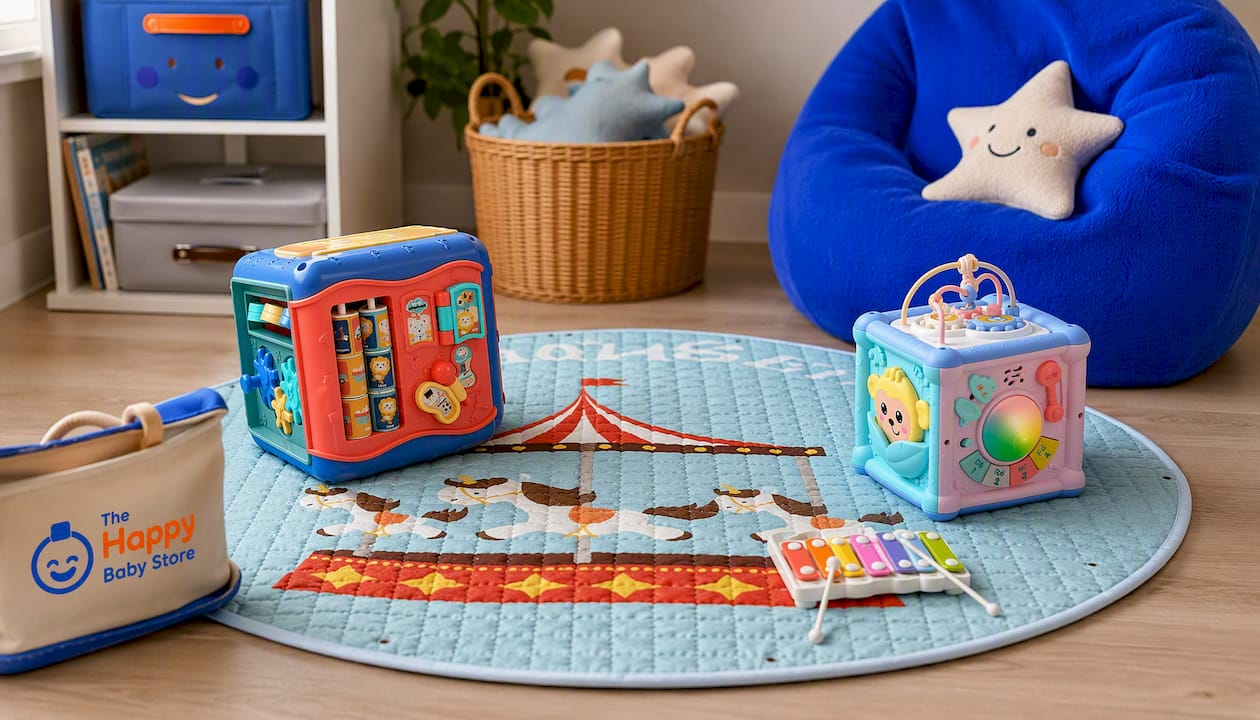
Here’s how each of Thehappybabystore’s most useful rotation pieces fits into a real setup:
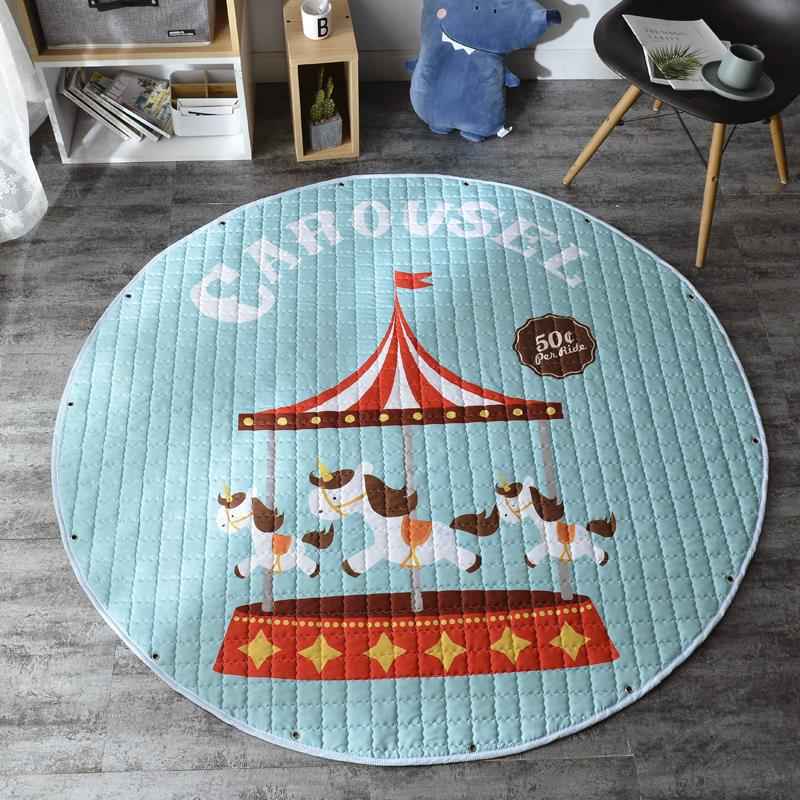
- The round crawling mat with built-in storage works as both a contained play zone and a spot to stash the current rotation set, which matters most in a small nursery.
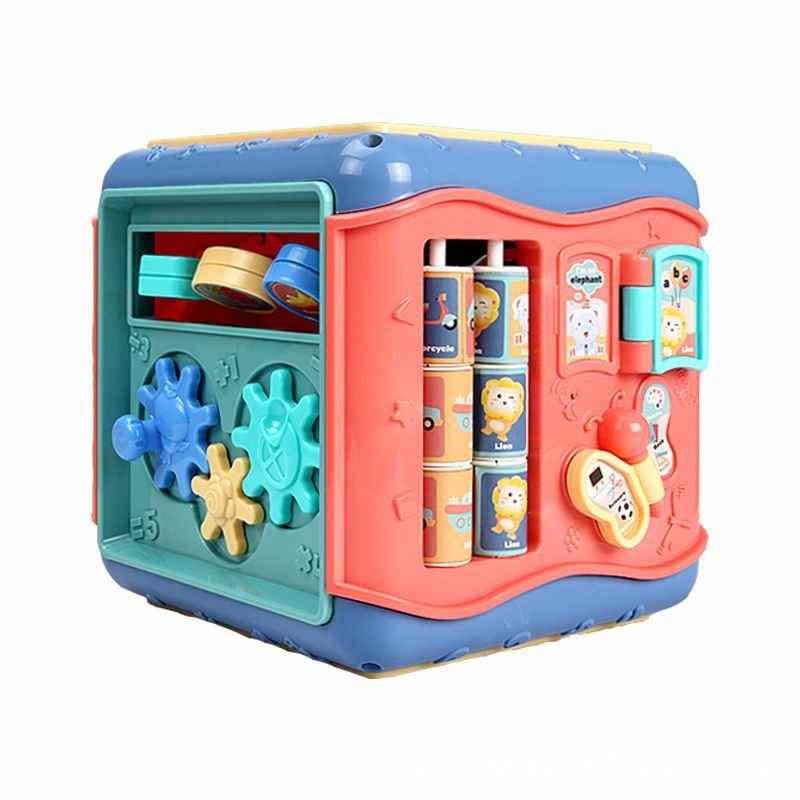
- The hexahedron activity cube covers multiple skill categories in one object, making it a strong anchor piece in toddler sets rather than something you cycle out.
- The multi-activity cube suits shared family bins, since siblings at different ages tend to use its different faces in different ways.
| Product | Best rotation role | Fits which age range |
|---|---|---|
| Round crawling mat with storage | Contained play surface plus hidden storage | Infant to toddler |
| Hexahedron activity cube | Semi-permanent anchor toy | Toddler |
| Multi-activity cube | Shared family bin item | Toddler to preschool |
What I’d Tell a Friend Setting This Up
Most articles on this topic treat toy rotation like a productivity system, color-coded labels, laminated schedules, a spreadsheet tracking which bin goes where. That’s backwards. The research doesn’t support rigid calendars; it supports fewer toys and reduced visual noise, full stop. The scheduling part is just logistics you bolt on afterward.
Where conventional advice overcomplicates things is storage. Parents delay starting because they think they need matching bins from a specific store or a dedicated playroom shelving unit. You don’t. A shoebox and a closet shelf accomplish the same novelty reset as a $200 cart. Spend your effort on the sorting and the anchor-toy decisions, not the containers.
If I had to pick one priority for someone starting this week, it’s this: identify the two or three toys your child would be genuinely upset to lose, set those aside as permanent anchors, and rotate everything else without guilt. That single decision prevents almost every meltdown parents report when they first try rotation, and it’s the piece most guides skip entirely.
— Enrique
Give Your Rotation System the Right Tools
Thehappybabystore built its play and storage products around exactly this problem: too many toys, not enough contained space to rotate them properly. Instead of buying generic bins that don’t quite fit a nursery corner, the round crawling mat with built-in storage gives you a defined play zone and a hidden compartment in one piece, so the “where does the current set live” question solves itself.
For the anchor toy every rotation set needs, the hexahedron activity cube and multi-activity cube are both built to handle daily use across multiple developmental stages, which means you’re not restocking a flimsy toy every few months. Every product is child-tested against medical-grade safety standards before it reaches a nursery. If you’re setting up your first rotation system this week, browse the crawling mat and storage options and add one anchor toy to get your first 6 to 8 item set ready by the weekend.
Sources
A few pages informed the practical advice throughout this piece, each worth reading if you want more depth on a specific piece of the system:
- Refreshing playtime: a Montessori approach to toy rotation
- Toy Rotation: A Step by Step Guide
- Toy Rotation System With Bins That Actually Works (No Fancy Playroom Needed)
- Create a Toy Rotation System That Actually Works! - Kids Who Play
- How does having fewer toys around change a toddler’s play?
Recommended
- Engaging Multi-Activity Cube for Kids | Happy Baby – The Happy Baby Store
- Wooden Rainbow Stacking Tower Toy - Unleash Creativity & Learning – The Happy Baby Store
- Interactive Twister Play Mat - Family Fun & Active Games – The Happy Baby Store
- Clutter-Free Baby Diaper Organizer - Your Solution for Nursery Chaos – The Happy Baby Store


