


Skip the microwave. It heats milk unevenly, leaving pockets hot enough to burn your baby’s mouth even when the bottle feels fine from the outside. A warm water bath, running warm tap water, or a proper bottle warmer are the safe choices, and each works well depending on your routine. If you’re warming bottles multiple times a night, a warmer earns its spot on the counter. If it’s occasional, a bowl of warm water does the job just as well.
TL;DR:
- Using a water bath or a dedicated bottle warmer is safer and more consistent than microwaving, which can create dangerous hot spots.
- Most warmers heat bottles within five to eight minutes, matching the rapidity of warm water methods but offering more convenience and predictability.
- Warm water methods are low-cost and require minimal maintenance, while warmers offer better temperature control and ease of use, especially during night feeds.
- Rewarming breast milk below 104°F preserves its bioactive properties, while microwaving can degrade antibodies, enzymes, and fats.
- Swirling and wrist testing are crucial safety steps regardless of warming method, as device displays alone cannot guarantee uniform temperature.
Table of Contents
Bottle Warmer vs Microwave vs Warm Water: Quick Comparison
Once you rule out the microwave, the real decision is between a dedicated warmer and a low-tech water method, and the right answer depends on how often you’re warming bottles and where you tend to do it.
Safety separates these options fast. Microwaving carries a real risk of hot spots and burns, while a warm water bath, running tap water, and a properly used bottle warmer all fall into the “low risk when done correctly” category, according to CDC guidance on handling breast milk. Speed is closer than most parents expect. An 8-ounce bottle set in a bowl of warm water typically reaches feeding temperature in about seven to eight minutes, based on testing from MSU Extension, and many bottle warmers land in a similar range once you factor in filling the reservoir and waiting for the cycle to finish.
Here’s how the main factors stack up:
- Safety: Water bath, running tap water, and quality warmers are all low risk when used correctly; microwaving is not recommended by Cincinnati Children’s Hospital or any major pediatric body.
- Speed: Expect 5 to 8 minutes for a 4 to 8-ounce bottle with warm water or a standard warmer; steam and circulating-water models can shave off a minute or two.
- Portability: A portable bottle warmer or USB warmer travels well; a warm water bowl needs a kitchen or a hotel sink.
- Cost and cleaning: Warm water costs almost nothing and needs no upkeep; warmers cost more upfront and need occasional descaling.
For a two AM feed when you’re half asleep, a warmer that beeps when it’s done takes one decision off your plate. For daytime feeds at home, a bowl of warm tap water is just as safe and costs nothing.
Why Are Microwaves Unsafe for Warming Baby Bottles?
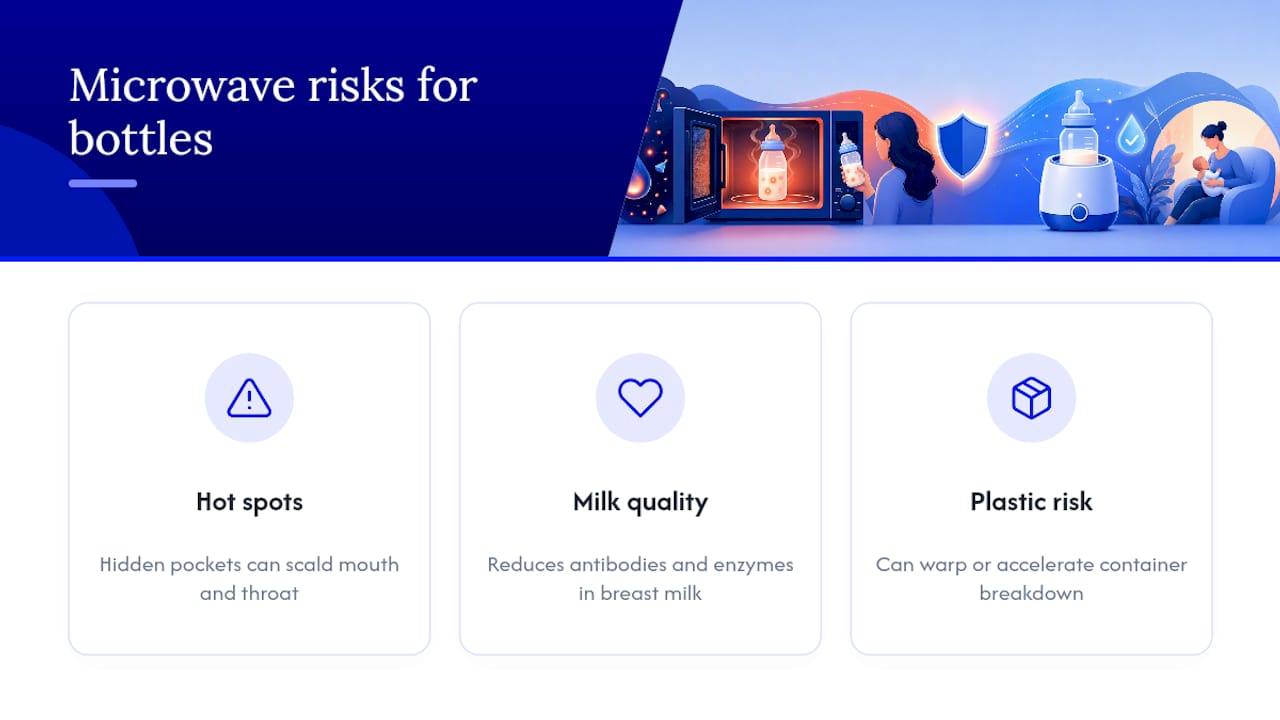
Microwaves cook from the inside out in a way that’s wildly inconsistent, and that inconsistency is exactly what makes them dangerous for baby bottles. Radiation heats water molecules unevenly depending on where they sit in the bottle, which means the milk near the center or bottom can run far hotter than the milk near the surface, even though the whole bottle feels lukewarm when you touch it.
That gap isn’t small. Internal hot spots can be significantly hotter than the surrounding liquid, hot enough to scald a baby’s mouth and throat on the first swallow. This is the core reason the CDC advises against microwaving breast milk or formula entirely.
A bottle can feel perfectly warm in your hand while a hidden pocket inside is hot enough to burn. That mismatch between what your wrist tells you and what’s actually happening inside the bottle is the reason pediatric guidelines rule out the microwave altogether.
There’s a second issue beyond burns. Microwave heating can reduce some of the anti-infective and bioactive properties in breast milk and disrupt how fat distributes through it, according to La Leche League. Breast milk isn’t just calories. It carries antibodies and enzymes that respond poorly to fast, uneven heat, so even setting burns aside, you’re potentially trading away some of what makes breast milk valuable.
Plastic bottles add a third concern. Repeated microwave use can warp certain plastics or accelerate the breakdown of container materials, particularly with cheaper bottles not rated for microwave use.
The standard swirl-and-wrist-test that works so well for water baths and warmers doesn’t reliably catch a microwave hot spot, because you’re testing the surface temperature of milk that hasn’t fully mixed. A quick swirl can make a bottle feel evenly warm on your wrist while a pocket deeper inside stays scalding. That’s the mismatch behind many of the scald injuries documented in pediatric literature: the test felt fine, but the milk wasn’t actually uniform.
How Do Bottle Warmers Work, and Are They Worth It?
Bottle warmers aren’t all built the same way, and knowing the difference helps you pick one that matches your routine instead of just grabbing whatever’s cheapest.
- Steam warmers heat a small amount of water into steam that surrounds the bottle, warming it quickly but sometimes unevenly near the cap.
- Hot-water reservoir warmers submerge the bottle in heated water, similar to a bowl but with a thermostat controlling the temperature.
- Circulating-water warmers actively move heated water around the bottle, which Wirecutter’s testing found holds a target temperature more consistently than simpler designs.
- Convection or air warmers use warm air instead of water, which tends to be slower but eliminates any water cleanup.
- Portable or USB warmers run on battery packs or car outlets, trading some heating power for the ability to warm a bottle in a car seat or a stroller.
Realistically, most of these land in the same five to eight minute window as a warm water bowl. Wirecutter’s product testing found that even top-rated warmers are often only modestly faster than doing it by hand, though circulating-water models do a noticeably better job of holding the exact target temperature without babysitting the process.
Where a warmer actually earns its keep is routine, not raw speed. Predictability matters most during a 3 AM feed, when you want to press one button and trust the result instead of testing water temperature with your hand while half awake. It also makes handoffs to a partner, grandparent, or babysitter smoother, since anyone can follow the same steps without guessing.
Pro Tip: Look for a warmer with an automatic shut off and a visible temperature readout. Those two features do more for real-world safety than any marketing claim about warming speed.
On the maintenance side, warmers need occasional descaling if you’re in a hard water area, and not every model fits wide-neck or glass bottles. Check bottle compatibility before you buy, especially if you’re using glass feeding bottles, since some warmer reservoirs are sized for narrow plastic bottles only.
How Do You Safely Warm a Bottle Step by Step?
Three methods work well and none of them involve a microwave. Pick based on what’s available and how much time you have.
Warm water bath:
- Fill a bowl or pot with warm, not boiling, water.
- Submerge the sealed bottle, keeping the water below the cap to avoid contamination.
- Let it sit for roughly 5 to 8 minutes for a 4 to 8-ounce bottle, checking periodically.
- Swirl gently to even out the temperature and redistribute fat.
- Test a few drops on the inside of your wrist. It should feel warm, not hot.
Running warm tap water:
- Hold the sealed bottle under a stream of warm tap water, rotating it for even exposure.
- This usually reaches feeding temperature faster than a still bowl for smaller bottles, and it’s the go to method when you’re in a hurry, as Cincinnati Children’s Hospital recommends.
- Swirl and wrist test before feeding, same as with the water bath.
Using a bottle warmer:
- Fill the reservoir to the manufacturer’s line.
- Set the target temperature to around 98°F, close to body temperature, and avoid exceeding roughly 104°F, the threshold where some bioactive properties in breast milk begin to change.
- Run the cycle, which typically takes 3 to 6 minutes depending on the model and bottle size.
- Swirl and wrist test regardless of what the display says. Devices can misread, but your wrist won’t lie.
- Rinse the reservoir after each use to prevent mineral buildup.
If you’re caught without a warmer and without a bowl handy, running warm tap water is your fallback every time. It’s fast, requires no equipment, and keeps you far away from the risks of a microwave.
How Should You Handle Warmed and Thawed Milk Safely?
Thawing frozen breast milk rewards patience. The best method is moving it to the refrigerator overnight, then finishing it with a brief warm water bath or running warm water if you need it sooner. Skipping straight to the microwave undoes the careful thawing process and reintroduces the same hot spot risk you’d get warming a fresh bottle.
Keep the target below roughly 104°F. Past that point, some of the bioactive properties in breast milk start to break down, which is part of why slow, gentle warming beats anything fast and aggressive.
Once milk or formula is warmed, the clock starts running:
- Prepared formula that’s been warmed should be used promptly and discarded if not finished, without reheating a second time.
- Formula should generally be used within 2 hours of preparation even if it hasn’t been warmed yet, according to safety guidance on warming windows.
- Breast milk follows similar discard rules after warming. When in doubt, toss the leftover rather than saving it for the next feed.
If someone else is feeding your baby, whether that’s a partner, a grandparent, or daycare staff, write the prep time on the bottle with a piece of tape or a dry erase label. It sounds small, but it’s the easiest way to prevent a warmed bottle from sitting out too long because nobody remembers when it left the fridge.
When Should You Buy a Bottle Warmer Instead of Using Water?
Buying a warmer makes sense once warming bottles stops being occasional and starts being constant. A few questions help settle it:
- How often are you warming bottles? Multiple times a day, especially overnight, tips the scale toward a warmer.
- Are multiple caregivers involved? A warmer with a clear display and auto shut off is easier to hand off than “warm it until it feels right.”
- Do you travel or commute with bottles? A portable bottle warmer or USB warmer solves a problem a kitchen sink can’t.
- What are your bottles made of? Glass and wide-neck bottles need a warmer sized to fit them.
- What’s your budget? Warm water costs nothing; a decent warmer is a one-time purchase that saves time night after night.
If those checkpoints add up, prioritize these features over anything else on the box:
- Accurate temperature control with a visible readout, not just a dial with no numbers.
- Automatic shut off so a forgotten bottle doesn’t overheat.
- Easy-to-clean parts, since a warmer you dread cleaning is one you’ll eventually stop using.
- Portability if travel or shared caregiving is part of your routine.
For families warming several bottles a day, Thehappybabystore’s double bottle warmer and sterilizer handles volume without doubling your counter clutter. For day trips and errands where a warmer isn’t practical, an insulated bottle that holds temperature for hours can skip the warming step altogether.
Why We Focus on Safety-Tested Feeding Products
Thehappybabystore built its feeding lineup around one question: does this make a stressed, sleep-deprived parent’s routine safer and easier, not just faster? That’s why every warmer and bottle in our catalog gets checked against child-safety standards before it earns a spot on the shelf, and why we’ve leaned into features like auto shut off and accurate temperature displays instead of gimmicks.
Portable and USB warmers matter more than most new parents expect. A 2 AM feed doesn’t wait for you to find a working outlet, and a car ride with a screaming baby isn’t the time to discover your warmer needs a full kitchen setup. That’s the gap our travel-ready warmers and insulated bottles are built to close.
Enrique, who covers infant product safety for this site, has spent years tracking how pediatric guidance on feeding translates into real buying decisions for families who don’t have time to read every label themselves.
Do Bottle Warmers or Microwaves Use More Energy?
Bottle warmers use a small, steady amount of electricity per cycle, typically comparable to a phone charger running for several minutes. Microwaves draw far more power in a shorter burst, but since microwaving isn’t a safe option for baby bottles in the first place, the comparison matters less for safety and more for households weighing overall energy use.
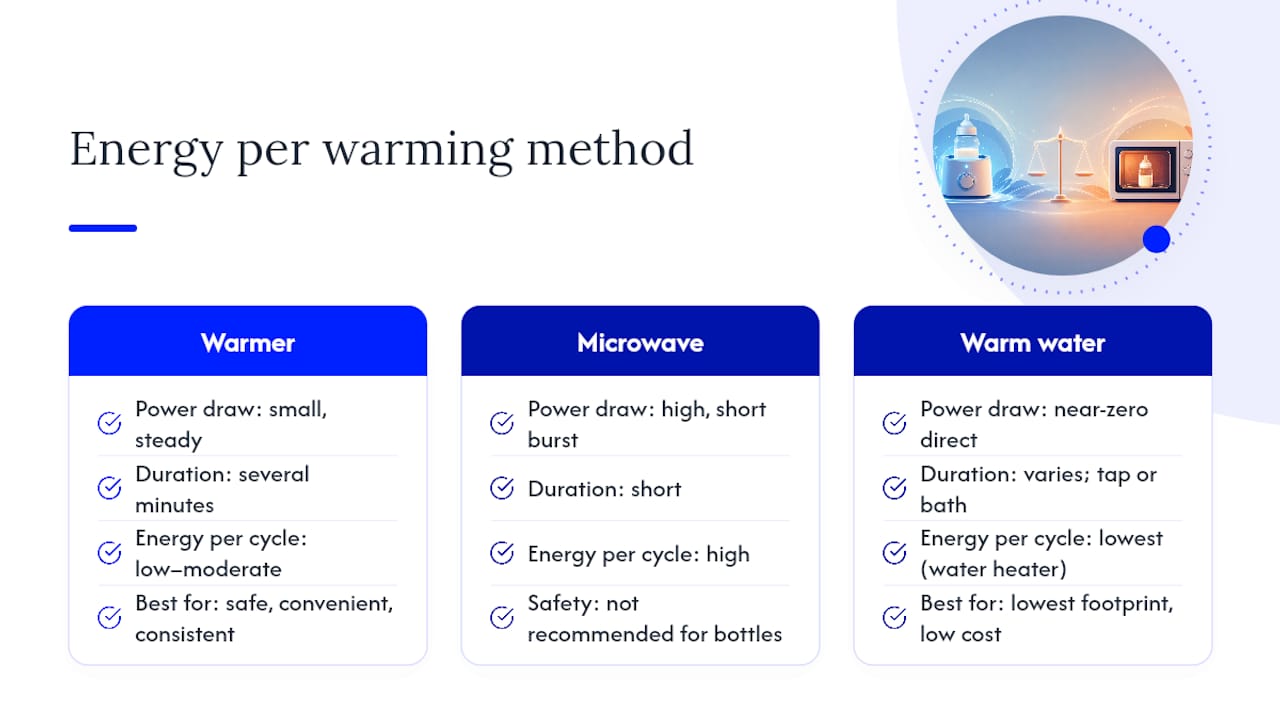
A warm water bath or running tap water carries almost no direct energy cost beyond the water heater already running in your home, making it the lowest-footprint option of the three by a wide margin. If you’re warming bottles five or six times a day, that adds up over a year more than most parents realize, even though each individual warming cycle looks trivial on its own.
Where a warmer’s energy use becomes worth it is convenience layered on top of safety. You’re not choosing a warmer because it’s more efficient than a bowl of water. You’re choosing it because it’s consistent, hands-off, and easier to hand to a tired partner at 3 AM. If minimizing energy use is a priority alongside safety, a warm water bath remains the leanest option on every front: cost, cleanup, and electricity.
For families who already own a warmer, running it only when needed rather than leaving it plugged in and idle cuts down on standby power use, a small habit that adds up the same way turning off lights does.
Does Warming Method Affect Breast Milk or Formula Quality?
How you warm milk changes more than temperature. It can change what’s actually in the milk by the time your baby drinks it. Gentle, gradual warming through a water bath or a well-calibrated warmer preserves far more of breast milk’s bioactive value than fast, uneven heat does.
Microwaving is the biggest offender here. Beyond the burn risk, microwave heating can reduce anti-infective and bioactive properties in breast milk and disrupt fat distribution, meaning your baby may be getting less of the immune support that makes breast milk valuable in the first place. That’s a quiet cost most parents never see, since the milk still looks and smells normal.
Staying under roughly 104°F protects those properties, while pushing past that threshold starts to break them down, according to MSU Extension’s guidance. This is part of why the target temperature for warmed milk sits so close to body heat rather than anywhere near boiling.
Formula is more heat-stable than breast milk since it doesn’t carry the same living antibodies, but it still benefits from slow, even warming rather than the scorched-then-cold unevenness a microwave produces. Swirling after warming, whether you used a bowl, running water, or a warmer, helps redistribute fat and any settled nutrients evenly through the bottle, one more reason that simple habit is recommended across every safe warming method.
What Actually Matters Most in This Debate
Most of the advice out there treats bottle warmers like a safety upgrade over a bowl of water, and that’s not quite right. The water bath is just as safe as a good warmer, provided you swirl and wrist test every single time. What a warmer actually buys you is consistency under pressure, not a safety feature the water bath lacks.
The habit that protects your baby more than any product is the same regardless of method: swirl, test, and trust your wrist over any device’s display. Skipping that step is where scald risk creeps back in, warmer or not.
Where I’d push back on conventional wisdom is the idea that you need to pick one method forever. Most families end up using a warmer at night for the predictability and warm tap water during the day because it’s faster and requires zero setup. That flexibility, not brand loyalty to one gadget, is what actually makes feeding routines sustainable through the newborn stretch.
— Enrique
Find the Right Warming Setup for Your Routine
If you’re warming bottles more than once a night, Thehappybabystore’s approach saves you from guessing whether tonight’s bottle is safe. Our portable bottle warmer gives you the same swirl-and-wrist-test reliability of a warm water bath, but with a consistent target temperature and auto shut off built in, so a groggy 3 AM feed doesn’t turn into a guessing game.
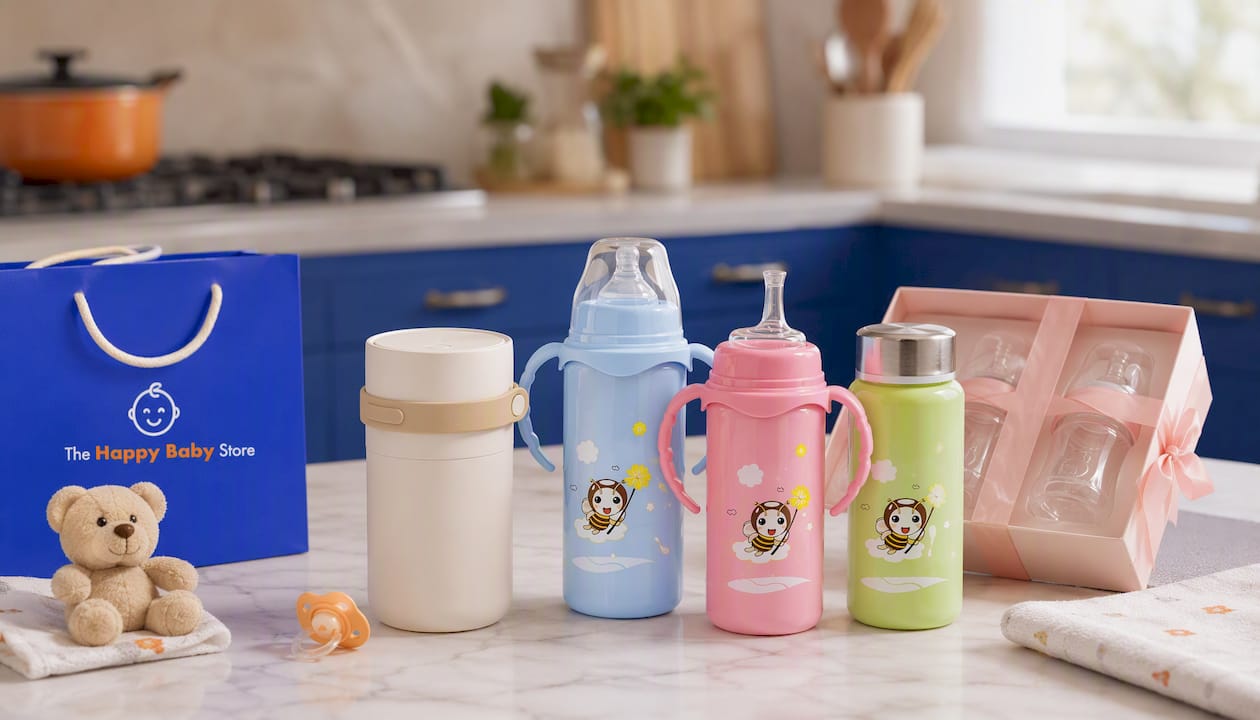
For families who live in glass bottles, our borosilicate glass feeding bottle pairs with gentle warming methods without the plastic-warping worries that come with microwave use. And if your day involves more stroller time than kitchen time, the insulated feeding bottle keeps milk at temperature for hours, skipping the warming step during long outings altogether.
Browse Thehappybabystore’s feeding collection and find the setup that matches how you actually feed your baby, day or night, home or on the road.
This article is general information, not a substitute for advice from a qualified doctor. Consult a qualified healthcare professional about your own circumstances before acting on anything here.
Sources
- CDC — Handling and Storage of Breast Milk
- Cincinnati Children’s Hospital — Warming formula or breast milk
- MSU Extension — Safely warming up baby formula and breastmilk
- Wirecutter (The New York Times) — The 2 Best Bottle Warmers of 2026
Recommended
- Double Bottle Warmer for Babies: Effortless On-the-Go Feeding – The Happy Baby Store
- Portable Baby Bottle Warmer by Happy Baby | On-the-Go Comfort – The Happy Baby Store
- Portable Bottle Warmer for Parents | Cordless Warmth on the Go – The Happy Baby Store
- USB Baby Bottle Warmer by Happy Baby | Effortless Feeding – The Happy Baby Store


